“Pranchiyettan …” is, I believe, director Ranjit giving the finger to those who had labeled him a “Hinduvta” director after a series of movies such as Devasuram, Ravanaprabhu, Nandanam, Prajapathy etc.
There have been several movies based on the Kottayam Christian milieu; however movies set in Thrissur are rare. Other than Padmarajan’s Thoovanathumbikal, I can remember no other movie that has used the town and its slang as an important facet in the movie.
It is refreshing that the movie has no “villains”. Siddhique is portrayed as Pranchi’s main rival, but Ranjit has resisted the temptation of having either the hero or villain import a dozen ruffians from several different places, and indulge in an outlandish fight sequence.
The whole bit about hints around the hypocritical lives lead by Siddhique and Khushboo was uncalled for – a cheap shot, really. Could Pranchi not find his happiness even as his childhood sweetheart and her husband lived happily too?
The whole speech sequence was awesome. It reminded me a bit of the iconic “balatkaar” sequence from “3 Idiots”; but the one in “Pranchiyettan…” was more about the fear of public speaking.
The whole concept of “Padmashree-chasing” was a riot. Ranjit clearly has a ball here, with digs at all and sundry.
Jagathy could have been avoided. He added absolutely nothing to the movie, and did nothing new (other than demonstrate a few Yoga poses) either.
Finally, what does one say of Mammootty? This amazing performance is most un-Mammootty-like; in fact it is almost Mohanlal-esque, except for the spotless Thrissur slang (which I think Mohanlal could not have quite managed). We all know that Mammootty excels in statuesque roles, but to see him excel as the self-deprecating Pranchi reminds us that the veteran still has unexplored depths. More innovative scripts please!
The dearth of interesting story lines in Malayalam cinema continues. As a result, there are more sequels being planned in Mollywood:
Pranchiyettan vs. Manickyam: Mammootty in an exciting double role re-enacting his memorable roles from the two blockbusters. A special wig has been ordered from Washington D.C. Osama: Major Ravi exposes how the real Osama assassination went down in 2011. The focus of the story is Brigadier Mahadevan (Mohanlal), who had personally assisted the US SEAL team in bringing down the fugitive, but ended up losing credit in the end.
CBI Umpteen: K.Madhu, S.N.Swamy, and Mammootty reunite to reprise Sethurama Iyer, one of the most memorable characters of Malayalam cinema.
Indhuchoodan: Amal Neerad brings back the iconic Indhuchoodan. Alphonse is doing a re-mixed version of the Narasimham theme music that is being rendered by Jassie Gift.
Ormayundo Ee Mukham: Suresh Gopi is back as Bharatchandran I.P.S, the character that elevated his career. Renji Panicker directs, and promises a thriller that reflects the latest political happenings in Kerala.
Rajavinte Makan: Shaji Kailas remakes this Mohanlal classic with Prithviraj in the lead.
20-80: Prithviraj Sukumaran stars and produces the sequel to 20-20, and re-unites the entire Malayalam film industry. Dileep will appear in a special item number sung by Aditya Narayan as an additional attraction. The great-grandfather of Malayalam cinema, Mr. Joshiiee, will be directing the sequel as well.
After the disappointing “Calcutta News”, Blessy bounces back into some semblance of form with “Bhramaram”. Although “Bhramaram” is certainly not up to the high standards set by the director’s own “Kazhcha” and “Thanmatra”, it is nevertheless an interesting watch ably shouldered by a burly Mohanlal. From the time Mohanlal (Jose albeit Sivankutty) lands up at stockbroker Unni’s doorstep at Coimbatore, there is an air of foreboding about “Bhramaram”. Lal’s furtive glances and expressions add to the suspense. The movie proceeds on more or less a familiar path, until that stage of the film which reveals that Unni is about to embark upon the journey of his life with Sivankutty – not exactly the most amenable of companions. It is post-intermission that the movie comes on to its own, and hurtles toward the inevitable tragic climax.
*** Spoilers ahead *** “Bhramaram” falters mainly in its pace. For one, character development is long drawn, and not particularly effective. For instance, Blessy hammers in again and again the fact that Sivankutty loves kids (as if Mohanlal would play a paedophile in a mainstream Malayalam film). In a similar fashion, there is a completely unnecessary sequence involving a run-in with truck drivers – that whole segment ought to have been edited out. The first half of the film totters about with no real aim (except maybe to “tell” the audience again and again that Mohanlal is playing an eccentric, unpredictable character) while the second half is fairly eventful. Worst of all, the sudden “guilt-attack” and subsequent confession looks awfully forced and hurried – almost as if the producer cracked the whip or something! My gut tells me that “Bhamaram” would have worked awfully better as a true road move, with a firm editor holding the scissors. Bharathan’s “Thazhvarom” is an excellent example of a film in a similar genre being handled in a much more controlled manner.
In the end, it is once again Mohanlal who hoists the film to a different level altogether. His burly demeanor, furtive body language, and expressive eyes convey a lot more than most of his dialogues, making them redundant. Mohanlal gets completely into the skin of the eccentric Sivankutty, except during the silly flashback where everybody hams (especially the irritating kid). Suresh Menon does a good job – a very effective foil to Mohanlal.
Verdict: Mohanlal makes this a must-watch, especially as interesting movies from him seem to be becoming extinct.
College Kumaran: With Mohanlal in the title role. Perhaps a better title would have been College Kumarante Achchan.
Sound of Boot: Very apt, as the audience 'booted' it out of the theatres without a qualm.
De Ingottu Nokkiye: Nobody gave the movie even a first glance, despite the director trying to milk some controversy from some canned scenes.
Innovative Concepts:
An ex-major who has resigned his post (with no apparent repercussions) and opted to run the college canteen, with occasional forays into activities like coaching students, taking on corrupt politicians, helping out orphans in distress, bashing up stray goondas etc. Extremely original.
A love story starring Mammootty prancing around in leather outfits in Singapore, I presume. There's even a fashion show where M struts his stuff - (s)exciting, huh?
Suresh Gopi in yet another 'different' role, this time as a sanyasi detective - bet even Agatha Christie couldn't have thought of this one.
Dileep (Mulla) is a hardened criminal, who is forced to care for a baby. Within some days, the baby changes his behavior, arousing and developing the sense of empathy and humanity in the cold blood killer. Very, very original.
The English Scholar Award:
Move over, Suresh Gopi and Mammootty - M.G.Sreekumar is here. With buzz words like 'Audien' and 'Criticization', rumor has it that Renji Panicker is planning to cast M.G.Sreekumar in his latest abusive saga of cussing, swearing, and filpping the bird.
Best Director:
Balachandra Menon for De Ingottu Nokkiye (roughly translated to Hey! Look Here!). Not content with writing and directing this neo-classic, the director also appeared on several channels accusing others of 'chopping' his creation. Never miss a trick for publicity, huh?
Comeback of the Year:
Jayaram should have been a cakewalk for this reward; he had his first post-millennium hit, riding on the petite shoulders of Gopika, and worked hard to revive some of his old mimicry tricks.
However there was another unexpected comeback in 2008 that had audiences whistling in joy, and dancing in the aisles. Yes - I am refering to the one actor in the history of Malayalam cinema who encompassed all emotions into one expression; who modulates his dialogue delivery like no other; who screeches like a jackal when delivering the only authentic karate kick of Malayalam cinema - none other than Babu Anthony in 20-20.
Performances of the Year:
Mohanlal in College Kumaran lends new expression to the word sleepwalking. In a role he is clearly disinterested in, Lal barely goes through the motions - leading to the question why exactly he signed the movie.
Mammootty in Annan Thambi on the other hand, is loud, ebullient and thoroughly irritating - I almost prefered the sleepwalking Lal. I can at least figure out why Lal walked through CK in a daze; but why Mammootty invested all his energy into a movie as inane as AT defies logic.
Old Wine in New Bottle Award:
Unanimously to Sathyan Anthikkad for re-inventing, re-polishing, re-painting, and re-selling the same wheel over and over again.
It is after a long time that one sees Mohanlal really sink his teeth into a role worthy of his talent. Although 'Paradesi' ends up being a tad disappointing, the performances alone make this movie a worthy watch.
As the title indicates not-so subtly, the tale is about Indian Muslim expatriates who live a life of misery and fear ever since the partition. Instead, the director opts to iterate through a string of characters, tracing their lamentable history through the weary eyes of Moosa (Mohanlal). Despite being treated to a virtual acting exhibition by a list of Malayalam actors, being subjected to different variations of the same story again and again does take its toll on the viewer. A little bit of subtlety would have gone a long way in raising this film to another level altogether, I couldn't help but think. In what ought to have been a landmark role, Mohanlal is curiously apathetic as the young Moosa - lackluster would be the one would be tempted to use if it were not for the marvelous turn Mohanlal turns in as the aged, harried Moosa. In both body language and voice modulation, Mohanlal is the aged Moosa personified - the one drawback is the apparent inability to imbibe the Malabar slang. Paternally affectionate with the young journalist, pensive as he discusses legal matters with the policemen and lawyers, despairing as he is banished yet again, cringing and pathetic as he attempts to hide from the policemen - there is apparently no emotion that Mohanlal cannot conjure up for Moosa. It is a pity that Mohanlal the actor is constantly drowned in tripe like Madambi and Hello.
Shweta Menon is truly a surprise as Moosa's wife, Aamina. It is a shocker of a performance - made all the more effective more by sheer shock value than actual histronics, one suspects. But nay; the very thought is cruel and unfair to an extremely competent Shweta.
There are quite a few effective cameos in the movie - Jagathy, Sidhique, Padmapriya, T.G.Ravi, Cochin Haneefa etc. Jagathy yet again reveals what an outstanding talent he really is - after the likes of Mazha and Nottam in recent times, he chews up the scenery as the mentally unhinged Abdul Rehman. It is a pity that this fine actor is more often than not relegated to asinine comic roles. The Lakshmy Gopalaswamy story was not effective though, and the stark depiction of police brutality was completely uncalled for. The akwardness between Moosa and Khafija was a deft touch - all the more so since it left unexplained.
It is directorially that the film falters. All the stories / characters are but clones of one another, and one could see the end coming a thousand miles away (though Mohanlal reserves his best for the final few scenes). A dash of subtlety and some firm editing might have done wonders to make a good film better.
Verdict: Laudable effort, but could have been so much better.
Since 'Rowdram' and 'Sound of Boot' have just been released, I thought it would be apt to run through what would typically runs through the minds of the likes of Renji Panicker and Shaji Kailas when planning a new movie.
The Hero: Suresh Gopi, Mammootty or Mohanlal. If its either of the first two, they can be educated from some fancy-sounding school outside Kerala (and mouth epithets like shit, crap, bullshit, damn etc in every couple of sentences), and also be the son or grandson of some retired honorable politician whose roaring days are over, thanks to backstabbing partners (who the hero can abuse during a later scene). If its Mohanlal, he's probably an orphan who migrated to an outside state/country when his parents were killed, and picked up classical music along the way. And yeah, a music composer needs to be hired as well - fit in a classical or semi-classical song somewhere. Otherwise, ominous-sounding background music would do (what are Enigma CDs etc for?).
The Heroine: Optional, only for eye-candy. Should be pretty, knowledge of English preferable (since there's only one female dubbing artiste in Kerala, who's knowledge of English would rival that of a kindergarten kid). Make her an honest government servant, like an policewoman, or a collector or sub-collector. Should be tough, but marshmallow in the hero's hands once he's called her a 'bitch' or something else equally derogatory.
Crony of Hero Who Dies Just Before Climax: Biju Menon, Tony or one of the new young blokes whose debut films have flopped. An orphan who the hero accosted in his childhood and brought home. Faithful companion, insert scene where crony cries and remembers his gratitude to hero.
The Betrayer: Pretty much the same as the crony, except the betrayer is money-minded (insert scene where the hero affectionately chides him for being so darned money-minded). To add insult to injury, this character has to suffer through the verbal diarrhea of the hero (insert couple of Sanskrit shlokas if Mohanlal, hire Sanskrit professor for 2 days of shooting) before being killed.
Hero's Father: Either a garlanded photograph on the wall, in which case an affectionate mom is mandatory, or some veteran actor like Madhu or Janarddanan who makes all the appropriate noises.
Hero's Mother: Mandatory only in certain cases, as outlined above. Pretty much delegated to serving food, and to the puja room. Probably fit in a scene where she worries about her son, and the dad consoles her saying that their son is a man (as opposed to Dileep). Poor Man / Woman Who Hero Helps: Usually, an out of work actor suitably disheveled. The character would be a victim of some tragedy, waiting for justice tearfully after being abused by the system and/or corrupt politicians and policemen. Enter the hero, who then delivers a lecture on how Gandhi said that the heart of India is with the poor etc, and promptly delivers justice. Object of Abuse: There's hardly any other way to describe the likes of Kollam Thulasi, Rajan P Dev, Devan, Shammi Thilakan etc - placed in the movie solely to provide the hero an opportunity to mouth off. These would usually be corrupt politicians / police officers. Typical verbal attacks include being called a pimp, being accused of being the hero's father's barber (or some such) who then proved ungrateful, and at the end (or just before interval) being asked to do a countdown, or insert an external object into a hidden body part.
The Villain: Sai Kumar or Siddhique, who seem to be our only charismatic actors around apart from the 2 Ms. They have nothing much to do except drink malt whiskey, slip in an oblique reference to Karunakaran/Antony, and then summon up suitably indignant expressions as the hero indulges in verbal diarrhea yet again.
That's it, that's the formula. And hey presto, you have the latest Mohanlal / Mammootty / Suresh Gopi blockbuster ready to hit the theatres!!
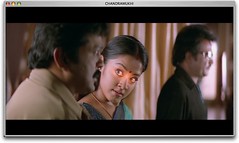
I just had to watch 'Bhool Bhulaiyya', Priyadarshan's psychological take on the neo-classic 'Manichithrathazhu', even if only to criticize. In many ways, it is much more ghastly than 'Chandramukhi', for this movie at least had the excuse that it had to be tailored to suit the Rajni persona (and in the bargain, throw any semblance of logic out of the window. Can't imagine why this line of thought seems to have stuck with all Rajni directors. Wasn't Dalapathy good and entertaining cinema?). With 'Bhool Bhulaiyya', Priyan has no such excuses, since he fails to retain even a glimmer of the spirit of the original despite investing in scene-by-scene remake. This, despite him being part of the original's crew.
In both remakes - and at this stage, it seems prudent to remove Chandramukhi from the comparisons for the same 'excuse' mentioned above - subtlety seems to be a big no-no. Nuances from the original - which is one of the most important reasons why it is regarded as a classic by the current generation - are discarded with disdain. Instead, we have uniformly bad acting - even from the normally dependable Paresh Rawal and Rajpal Yadav, who really ought to take a break from the buffoonery they have been up to in their recent outings.
Consider this: in 'Manichithrathazhu', there is a strong hint that Nakul (Suresh Gopi) is a neglectful husband - sample the scene where Ganga asks Nakul to bed, and he excuses himself citing the excuse that he has work to attend to. In fact, the lovely Varuvanillarumee Vijanamam Ee Vazhiyil number strongly indicates that Nakul might even be impotent ( a fact that is only indicated at in the various remakes by Prabhu's nuanced performance). Thus there is a strong foundation laid for the possibility that Ganga is neglected, bored out of her wits, and thus particularly vulnerable and empathetic to the legend of Nagavalli. Instead, here we have Shiney Ahuja all the time grinning like an idiot, and happily nuzzling a rather plump Vidya Balan during an incoveniently placed duet.
And then, there are scenes where Amisha simpers (in that excruciatingly teeth-grating way that only she can) about the rat poison left oh-so conveniently in the kitchen - much like in the Tamil version, where we have 10 laborers literally groaning and moaning to carry the bed across the corridor. I am not sure why the directors feel that Tamil and/or Hindi audiences need such dumbing-down - after all, these are the same audiences that made superhits of a 'Thevar Magan', a 'Lagaan' and a 'TZP'. Labels like 'hey, there's poison in the kitchen' and 'this bed, that the possessed heroine will later lift, is so darned heavy' are juvenile and overkill - perhaps expected of P.Vasu, who wouldn't recognize good cinema if it bit him on his plagiarizing ass, but certainly not of Priyan who has made a lot of good films in the past. Obviously, neither Jyothika nor Vidya are a match for Shobhana, who delivers a career-defining, knockout performance in the original. Jyothika overacts, to much merriment, and resorts to inane grins, light on the eyes etc to at least frighten the kids. Vidya Balan tries hard, though she's obviously watched DVDs of 'Manichithrathazhu' one too many times (never more obvious than in the scene where you can tell she's just yearning to pick up that bed)! Shobhana's expressions in the crucial scenes are phenomenal - attributable to bad/strange acting on first watch even if you notice the change of expression, but bang-on upon subsequent viewing. The most famous scenes, of course, are the ones with the psychiatrist displaying the jewelery with a manic fervor, the one at the temple where the psychiatrist deliberately tries to aggravate her, and then the by-now-classic scene with the lifting of the bed. Shobhana, despite not doing much of consequence after Manichitrathazhu, is a treeat to watch in what must rank as one of the greatest performances in the history of Indian cinema.
The psychiatrist is the main commercial ingredient of the movie - he provides comic relief, and acts as the main catalyst. At the risk of sounding biased, I just cannot imagine anyone other than Mohanlal in this role. His antics, like the one where he shakes his leg incredulously to check the sound of the anklet is coming from his leg, or the where he gazes lecherously at the portrait of the dancer, have by now been mimicked successfully by both Rajni and Akshay; however, most of these gestures were improvised by Mohanlal on the sets (does somebody have the link to the interview where Fazil said this?). While Rajni's role is ... well, more or less a typical Rajni role, Akshya Kumar copies Mohanlal's expresssions, body language and posture completely. He does a pretty decent job, but the magic is clearly not there.
The music of Manichitrathazhu was very important too, since the the alternate persona was a dancer-singer clearly well-versed with music; she sang and danced at night, after all. The Pazhamthamizh pattu number (conveniently ditched in the remakes, as the timing of the song placement was slightly awry) was not just a song randomly inserted into a scene; it was clearly the the doctor trying to soothe the alternate persona by singing a song in the same raaga as that of the one that the dancer dances to at night (the doctor hears this earlier, and hence he knows the song, so that loophole is closed as well).
I can keep going on and on; the original was a movie where all loopholes were plugged, and had several nuances/hints placed, only to tie them all up toward the end. Only several watches of the movie help you understand all of this. With the remakes,its difficult to sit through the movie even once - wild dogs couldn't drag me to a second screening.
Recently, I came across a beautiful piece on one of Padmarajan's oft discussed 'Thoovanathumbikal' on the Passion for Cinema blog. As the writer puts it, this is most definitely a movie that grows on you - disturbed characters, the use of symbols, and most of all, the loneliness that is the mark of the three principal characters make for some really compelling cinema. Indeed, there are not many directors who can convert literature to cinema so convincingly.
Here is the link to the piece - its worth your while. And this is something that I wrote last year about my favorite Padmarajan movies.






 Posts
Posts

