Friday, March 21, 2008
My New College: JanakiParvathyShakuntalaDamayanthi College of Education
Links courtesy HawkEye
Looking at how popular colleges like these are, I have decided to begin my own college in Chennai: Shree JanakiParvathyShakuntalaDamayanthi College of Exemplary Education. This will of course be a 'mixed' college, but also be a carefully 'controlled' environment so as to extol the finest virtues of discipline and self-control amongst students.
As Chairman, Counselor and Principal, my rules will be these:
a. All college buses will have two entrances - one for boys and the other for girls.
b. The buses will have a central partition, so that not even a carrot can be shared between the two sexes.
c. All girls should obligatorily carry an umbrella with them at all times (black in color).
d. When climbing up/down on stairs, girls should have their umbrellas open, so as to deter all eyes.
e. Furthermore, all girls should have their dupattas fastened with no less than 50 safety-pins at all times. This will be subject to random inspections, and anybody found with a number of pins lesser than the minimum will have to undergo punishment.
f. All HODs will be provided special mopeds /TVS Scooties so that they can roam around campus during 'free periods', and look around for offenders. Offenders will be punished harshly, and repeat-offenders will be dismissed.
g. Within the classroom, girls and boys will be separated using a one-way mirror partition on both sides. Each classroom will also have different entrances.
h. Girls (and boys) are forbidden from wearing makeup. At the most, kajal can be used.
i. No 'western' cultural programs will be allowed. Western Dance, Light Music, Skits etc are not allowed during cultural festivals. The only items / competitions permitted are classical dance, Bhajan competition, and skits from the Ramayana or Mahabharata.
j. No skit should have girls and boys participating at the same time. The dupatta rule applies during skits as well.
k. During competitions, cheering, catcalls, whistling etc are not allowed. At the end of every event, the event coordinator will lift his/her hand signalling permission to clap. The audience has to clap then, and only then.
l. Attendance for all competitions are mandatory.
m. Girls are not allowed to participate in sports events.
n. Girls are not allowed to view sports' events held for boys.
o. In the girls' hostel, the dupatta rule must be followed whenever there are any visitors.
p. In the visitors room of both the girls' and boys' hostels, all occupants must have both legs on the ground at all times.
q. All hostels will have speakers on the ceilings, which will start playing bhajans at 4:00 AM, and 6:00 PM. All lights in the rooms will be automatically switched on at this time as well. If any speaker is damaged, all occupants of the floor will be suspended.
r. All hostels will have a TV room. The TV will be locked in a glass case, and the hostel warden will decide what channel is to be place. The TV remote would be in the custody of the hostel warden at all times.
s. College tours are not permitted.
t. Hostel residents should be within the college campus by 6:00 PM.
Can't think of any more, going off to sleep !!

Sunday, March 16, 2008
Apocalypto: Film Review
As directors, there's more than one similarity between Mel Gibson and Kamal Hassan; both of them are talented and ambitious story-tellers with unique visions, both of them have a penchant for violence (of the gory kind, where blood sprays from the throat, and spears jut through flesh with the sickening sound of metal meeting flesh), both of them are comfortable tackling risky and controversial topics - so on and so forth. Oh, and neither of them shy away from making the odd sexual innuendo even in the most serious of movies. But neither of them are completely there as great directors, though both of them certainly having the making of great directors. Their respective directorial ventures, though certainly different from (and mostly a notch above) the run-of-the-mill stuff, and often featuring breathtaking moments / scenes, often fail to reach the heights that you'd expect they would. 'Apocalypto' is no different in this regard.
At its heart, 'Apocaypto' is a 'chase' movie. Of course, the director's conceit is that it is set amongst Mayan tribes, and hence offers a fresh (and rather interesting, one has to admit) look at an age-old cinematic concept. The film's hero, Jaguar Paw, who is probably an ancient ancestor of John Rambo, is snatched away from a joyous existence with his tribe, and hauled away to a 'modern' city where he is to be sacrificed before the sun-god, with a witchdoctor and a crowd-baying-for-blood in tow. This pretty much makes up the first half of the film, and the rest is about Jaguar Paw making his way home to his pregnant wife and son, who are stuck in a well.
It is entirely to Gibson's credit that he almost makes this work. The entire portion of the movie leading up to the siege of the village is the Mayan version of what a Sathyan Anthikkad, or a Bharathiraja regularly portray. Of course, the whole sequence about the aphrodisiac is more like from a '90s David Dhawan flick, but the bit about the young wife washing her mouth totally cracked me up. The invasion of the village, the killing of Jaguar Paw's father, and the whole sequence with the women is pretty brutal (especially the one with the woman who resists). The violence is unflinching, and the grueling journey from the village to the great city is beautifully picturized.
Unfortunately, the move lets you down in the second half. After the awesome escape sequence, and the breathtaking sequence with the jaguar, the move heads steadily downhill and never recovers. To somebody fresh from the horrors of watching Rambo muttachan (grandpa) gunning down people yet again, the hide 'n' seek in the jungle holds no new aspects. The insertion of gruesome violence yet again does not help the cause either. The only bit of suspense is about the wife stuck in the well, but by then you are beyond caring - there have been too many heads rolling down the steps, throats slit, people bitten by snakes, veins cut, heads hammered...you get the picture.
Like I had said earlier, the Gibson-Kamal connection is something that I have felt earlier too (though I think Kamal fancies himself more as a desi Quentin Tarantino). A lot of the imagery here reminded me of Virumandi - the haunting image of a woman stuck in a well while there's a massacre going on around her being the most pointed image, of course. Another point, IMHO, was the unnecessary use of gruesome and at times sadistic violence - as the best movies so often remind you, what's left unsaid and unseen often has the most impact, and its never more true than in this movie.
The Special Features section of the movie is a virtual feast. The amount of research they have put into the movie is staggering, and that would be an understatement. The tattoos, jewelery, clothes, hairdos, architecture, religious beliefs and the weapons - oh yeah, definitely the weapons - have been painstakingly researched. The technical team is so good that they just suck you up into the ambiance of the movie. The rain-forests look awesome, and the camera work is unobtrusive, yet fantastic.
In short: A great watch, but not for the faint-hearted.
At its heart, 'Apocaypto' is a 'chase' movie. Of course, the director's conceit is that it is set amongst Mayan tribes, and hence offers a fresh (and rather interesting, one has to admit) look at an age-old cinematic concept. The film's hero, Jaguar Paw, who is probably an ancient ancestor of John Rambo, is snatched away from a joyous existence with his tribe, and hauled away to a 'modern' city where he is to be sacrificed before the sun-god, with a witchdoctor and a crowd-baying-for-blood in tow. This pretty much makes up the first half of the film, and the rest is about Jaguar Paw making his way home to his pregnant wife and son, who are stuck in a well.
It is entirely to Gibson's credit that he almost makes this work. The entire portion of the movie leading up to the siege of the village is the Mayan version of what a Sathyan Anthikkad, or a Bharathiraja regularly portray. Of course, the whole sequence about the aphrodisiac is more like from a '90s David Dhawan flick, but the bit about the young wife washing her mouth totally cracked me up. The invasion of the village, the killing of Jaguar Paw's father, and the whole sequence with the women is pretty brutal (especially the one with the woman who resists). The violence is unflinching, and the grueling journey from the village to the great city is beautifully picturized.
Unfortunately, the move lets you down in the second half. After the awesome escape sequence, and the breathtaking sequence with the jaguar, the move heads steadily downhill and never recovers. To somebody fresh from the horrors of watching Rambo muttachan (grandpa) gunning down people yet again, the hide 'n' seek in the jungle holds no new aspects. The insertion of gruesome violence yet again does not help the cause either. The only bit of suspense is about the wife stuck in the well, but by then you are beyond caring - there have been too many heads rolling down the steps, throats slit, people bitten by snakes, veins cut, heads hammered...you get the picture.
Like I had said earlier, the Gibson-Kamal connection is something that I have felt earlier too (though I think Kamal fancies himself more as a desi Quentin Tarantino). A lot of the imagery here reminded me of Virumandi - the haunting image of a woman stuck in a well while there's a massacre going on around her being the most pointed image, of course. Another point, IMHO, was the unnecessary use of gruesome and at times sadistic violence - as the best movies so often remind you, what's left unsaid and unseen often has the most impact, and its never more true than in this movie.
The Special Features section of the movie is a virtual feast. The amount of research they have put into the movie is staggering, and that would be an understatement. The tattoos, jewelery, clothes, hairdos, architecture, religious beliefs and the weapons - oh yeah, definitely the weapons - have been painstakingly researched. The technical team is so good that they just suck you up into the ambiance of the movie. The rain-forests look awesome, and the camera work is unobtrusive, yet fantastic.
In short: A great watch, but not for the faint-hearted.
Saturday, February 09, 2008
Shit's The Word
Since 'Rowdram' and 'Sound of Boot' have just been released, I thought it would be apt to run through what would typically runs through the minds of the likes of Renji Panicker and Shaji Kailas when planning a new movie.
The Hero: Suresh Gopi, Mammootty or Mohanlal. If its either of the first two, they can be educated from some fancy-sounding school outside Kerala (and mouth epithets like shit, crap, bullshit, damn etc in every couple of sentences), and also be the son or grandson of some retired honorable politician whose roaring days are over, thanks to backstabbing partners (who the hero can abuse during a later scene). If its Mohanlal, he's probably an orphan who migrated to an outside state/country when his parents were killed, and picked up classical music along the way. And yeah, a music composer needs to be hired as well - fit in a classical or semi-classical song somewhere. Otherwise, ominous-sounding background music would do (what are Enigma CDs etc for?).
The Heroine: Optional, only for eye-candy. Should be pretty, knowledge of English preferable (since there's only one female dubbing artiste in Kerala, who's knowledge of English would rival that of a kindergarten kid). Make her an honest government servant, like an policewoman, or a collector or sub-collector. Should be tough, but marshmallow in the hero's hands once he's called her a 'bitch' or something else equally derogatory.
Crony of Hero Who Dies Just Before Climax: Biju Menon, Tony or one of the new young blokes whose debut films have flopped. An orphan who the hero accosted in his childhood and brought home. Faithful companion, insert scene where crony cries and remembers his gratitude to hero.
The Betrayer: Pretty much the same as the crony, except the betrayer is money-minded (insert scene where the hero affectionately chides him for being so darned money-minded). To add insult to injury, this character has to suffer through the verbal diarrhea of the hero (insert couple of Sanskrit shlokas if Mohanlal, hire Sanskrit professor for 2 days of shooting) before being killed.
Hero's Father: Either a garlanded photograph on the wall, in which case an affectionate mom is mandatory, or some veteran actor like Madhu or Janarddanan who makes all the appropriate noises.
Hero's Mother: Mandatory only in certain cases, as outlined above. Pretty much delegated to serving food, and to the puja room. Probably fit in a scene where she worries about her son, and the dad consoles her saying that their son is a man (as opposed to Dileep).
Poor Man / Woman Who Hero Helps: Usually, an out of work actor suitably disheveled. The character would be a victim of some tragedy, waiting for justice tearfully after being abused by the system and/or corrupt politicians and policemen. Enter the hero, who then delivers a lecture on how Gandhi said that the heart of India is with the poor etc, and promptly delivers justice.
Object of Abuse: There's hardly any other way to describe the likes of Kollam Thulasi, Rajan P Dev, Devan, Shammi Thilakan etc - placed in the movie solely to provide the hero an opportunity to mouth off. These would usually be corrupt politicians / police officers. Typical verbal attacks include being called a pimp, being accused of being the hero's father's barber (or some such) who then proved ungrateful, and at the end (or just before interval) being asked to do a countdown, or insert an external object into a hidden body part.
The Villain: Sai Kumar or Siddhique, who seem to be our only charismatic actors around apart from the 2 Ms. They have nothing much to do except drink malt whiskey, slip in an oblique reference to Karunakaran/Antony, and then summon up suitably indignant expressions as the hero indulges in verbal diarrhea yet again.
That's it, that's the formula. And hey presto, you have the latest Mohanlal / Mammootty / Suresh Gopi blockbuster ready to hit the theatres!!
The Hero: Suresh Gopi, Mammootty or Mohanlal. If its either of the first two, they can be educated from some fancy-sounding school outside Kerala (and mouth epithets like shit, crap, bullshit, damn etc in every couple of sentences), and also be the son or grandson of some retired honorable politician whose roaring days are over, thanks to backstabbing partners (who the hero can abuse during a later scene). If its Mohanlal, he's probably an orphan who migrated to an outside state/country when his parents were killed, and picked up classical music along the way. And yeah, a music composer needs to be hired as well - fit in a classical or semi-classical song somewhere. Otherwise, ominous-sounding background music would do (what are Enigma CDs etc for?).
The Heroine: Optional, only for eye-candy. Should be pretty, knowledge of English preferable (since there's only one female dubbing artiste in Kerala, who's knowledge of English would rival that of a kindergarten kid). Make her an honest government servant, like an policewoman, or a collector or sub-collector. Should be tough, but marshmallow in the hero's hands once he's called her a 'bitch' or something else equally derogatory.
Crony of Hero Who Dies Just Before Climax: Biju Menon, Tony or one of the new young blokes whose debut films have flopped. An orphan who the hero accosted in his childhood and brought home. Faithful companion, insert scene where crony cries and remembers his gratitude to hero.
The Betrayer: Pretty much the same as the crony, except the betrayer is money-minded (insert scene where the hero affectionately chides him for being so darned money-minded). To add insult to injury, this character has to suffer through the verbal diarrhea of the hero (insert couple of Sanskrit shlokas if Mohanlal, hire Sanskrit professor for 2 days of shooting) before being killed.
Hero's Father: Either a garlanded photograph on the wall, in which case an affectionate mom is mandatory, or some veteran actor like Madhu or Janarddanan who makes all the appropriate noises.
Hero's Mother: Mandatory only in certain cases, as outlined above. Pretty much delegated to serving food, and to the puja room. Probably fit in a scene where she worries about her son, and the dad consoles her saying that their son is a man (as opposed to Dileep).
Poor Man / Woman Who Hero Helps: Usually, an out of work actor suitably disheveled. The character would be a victim of some tragedy, waiting for justice tearfully after being abused by the system and/or corrupt politicians and policemen. Enter the hero, who then delivers a lecture on how Gandhi said that the heart of India is with the poor etc, and promptly delivers justice.
Object of Abuse: There's hardly any other way to describe the likes of Kollam Thulasi, Rajan P Dev, Devan, Shammi Thilakan etc - placed in the movie solely to provide the hero an opportunity to mouth off. These would usually be corrupt politicians / police officers. Typical verbal attacks include being called a pimp, being accused of being the hero's father's barber (or some such) who then proved ungrateful, and at the end (or just before interval) being asked to do a countdown, or insert an external object into a hidden body part.
The Villain: Sai Kumar or Siddhique, who seem to be our only charismatic actors around apart from the 2 Ms. They have nothing much to do except drink malt whiskey, slip in an oblique reference to Karunakaran/Antony, and then summon up suitably indignant expressions as the hero indulges in verbal diarrhea yet again.
That's it, that's the formula. And hey presto, you have the latest Mohanlal / Mammootty / Suresh Gopi blockbuster ready to hit the theatres!!
Monday, January 14, 2008
Manichithrathazhu: The Unmaking of a Classic
I just had to watch 'Bhool Bhulaiyya', Priyadarshan's psychological take on the neo-classic 'Manichithrathazhu', even if only to criticize. In many ways, it is much more ghastly than 'Chandramukhi', for this movie at least had the excuse that it had to be tailored to suit the Rajni persona (and in the bargain, throw any semblance of logic out of the window. Can't imagine why this line of thought seems to have stuck with all Rajni directors. Wasn't Dalapathy good and entertaining cinema?). With 'Bhool Bhulaiyya', Priyan has no such excuses, since he fails to retain even a glimmer of the spirit of the original despite investing in scene-by-scene remake. This, despite him being part of the original's crew.
In both remakes - and at this stage, it seems prudent to remove Chandramukhi from the comparisons for the same 'excuse' mentioned above - subtlety seems to be a big no-no. Nuances from the original - which is one of the most important reasons why it is regarded as a classic by the current generation - are discarded with disdain. Instead, we have uniformly bad acting - even from the normally dependable Paresh Rawal and Rajpal Yadav, who really ought to take a break from the buffoonery they have been up to in their recent outings.
Consider this: in 'Manichithrathazhu', there is a strong hint that Nakul (Suresh Gopi) is a neglectful husband - sample the scene where Ganga asks Nakul to bed, and he excuses himself citing the excuse that he has work to attend to. In fact, the lovely Varuvanillarumee Vijanamam Ee Vazhiyil number strongly indicates that Nakul might even be impotent ( a fact that is only indicated at in the various remakes by Prabhu's nuanced performance). Thus there is a strong foundation laid for the possibility that Ganga is neglected, bored out of her wits, and thus particularly vulnerable and empathetic to the legend of Nagavalli. Instead, here we have Shiney Ahuja all the time grinning like an idiot, and happily nuzzling a rather plump Vidya Balan during an incoveniently placed duet.
And then, there are scenes where Amisha simpers (in that excruciatingly teeth-grating way that only she can) about the rat poison left oh-so conveniently in the kitchen - much like in the Tamil version, where we have 10 laborers literally groaning and moaning to carry the bed across the corridor. I am not sure why the directors feel that Tamil and/or Hindi audiences need such dumbing-down - after all, these are the same audiences that made superhits of a 'Thevar Magan', a 'Lagaan' and a 'TZP'. Labels like 'hey, there's poison in the kitchen' and 'this bed, that the possessed heroine will later lift, is so darned heavy' are juvenile and overkill - perhaps expected of P.Vasu, who wouldn't recognize good cinema if it bit him on his plagiarizing ass, but certainly not of Priyan who has made a lot of good films in the past.

Obviously, neither Jyothika nor Vidya are a match for Shobhana, who delivers a career-defining, knockout performance in the original. Jyothika overacts, to much merriment, and resorts to inane grins, light on the eyes etc to at least frighten the kids. Vidya Balan tries hard, though she's obviously watched DVDs of 'Manichithrathazhu' one too many times (never more obvious than in the scene where you can tell she's just yearning to pick up that bed)! Shobhana's expressions in the crucial scenes are phenomenal - attributable to bad/strange acting on first watch even if you notice the change of expression, but bang-on upon subsequent viewing. The most famous scenes, of course, are the ones with the psychiatrist displaying the jewelery with a manic fervor, the one at the temple where the psychiatrist deliberately tries to aggravate her, and then the by-now-classic scene with the lifting of the bed. Shobhana, despite not doing much of consequence after Manichitrathazhu, is a treeat to watch in what must rank as one of the greatest performances in the history of Indian cinema.
The psychiatrist is the main commercial ingredient of the movie - he provides comic relief, and acts as the main catalyst. At the risk of sounding biased, I just cannot imagine anyone other than Mohanlal in this role. His antics, like the one where he shakes his leg incredulously to check the sound of the anklet is coming from his leg, or the where he gazes lecherously at the portrait of the dancer, have by now been mimicked successfully by both Rajni and Akshay; however, most of these gestures were improvised by Mohanlal on the sets (does somebody have the link to the interview where Fazil said this?). While Rajni's role is ... well, more or less a typical Rajni role, Akshya Kumar copies Mohanlal's expresssions, body language and posture completely. He does a pretty decent job, but the magic is clearly not there.
The music of Manichitrathazhu was very important too, since the the alternate persona was a dancer-singer clearly well-versed with music; she sang and danced at night, after all. The Pazhamthamizh pattu number (conveniently ditched in the remakes, as the timing of the song placement was slightly awry) was not just a song randomly inserted into a scene; it was clearly the the doctor trying to soothe the alternate persona by singing a song in the same raaga as that of the one that the dancer dances to at night (the doctor hears this earlier, and hence he knows the song, so that loophole is closed as well).
I can keep going on and on; the original was a movie where all loopholes were plugged, and had several nuances/hints placed, only to tie them all up toward the end. Only several watches of the movie help you understand all of this. With the remakes,its difficult to sit through the movie even once - wild dogs couldn't drag me to a second screening.
In both remakes - and at this stage, it seems prudent to remove Chandramukhi from the comparisons for the same 'excuse' mentioned above - subtlety seems to be a big no-no. Nuances from the original - which is one of the most important reasons why it is regarded as a classic by the current generation - are discarded with disdain. Instead, we have uniformly bad acting - even from the normally dependable Paresh Rawal and Rajpal Yadav, who really ought to take a break from the buffoonery they have been up to in their recent outings.
Consider this: in 'Manichithrathazhu', there is a strong hint that Nakul (Suresh Gopi) is a neglectful husband - sample the scene where Ganga asks Nakul to bed, and he excuses himself citing the excuse that he has work to attend to. In fact, the lovely Varuvanillarumee Vijanamam Ee Vazhiyil number strongly indicates that Nakul might even be impotent ( a fact that is only indicated at in the various remakes by Prabhu's nuanced performance). Thus there is a strong foundation laid for the possibility that Ganga is neglected, bored out of her wits, and thus particularly vulnerable and empathetic to the legend of Nagavalli. Instead, here we have Shiney Ahuja all the time grinning like an idiot, and happily nuzzling a rather plump Vidya Balan during an incoveniently placed duet.
And then, there are scenes where Amisha simpers (in that excruciatingly teeth-grating way that only she can) about the rat poison left oh-so conveniently in the kitchen - much like in the Tamil version, where we have 10 laborers literally groaning and moaning to carry the bed across the corridor. I am not sure why the directors feel that Tamil and/or Hindi audiences need such dumbing-down - after all, these are the same audiences that made superhits of a 'Thevar Magan', a 'Lagaan' and a 'TZP'. Labels like 'hey, there's poison in the kitchen' and 'this bed, that the possessed heroine will later lift, is so darned heavy' are juvenile and overkill - perhaps expected of P.Vasu, who wouldn't recognize good cinema if it bit him on his plagiarizing ass, but certainly not of Priyan who has made a lot of good films in the past.
Obviously, neither Jyothika nor Vidya are a match for Shobhana, who delivers a career-defining, knockout performance in the original. Jyothika overacts, to much merriment, and resorts to inane grins, light on the eyes etc to at least frighten the kids. Vidya Balan tries hard, though she's obviously watched DVDs of 'Manichithrathazhu' one too many times (never more obvious than in the scene where you can tell she's just yearning to pick up that bed)! Shobhana's expressions in the crucial scenes are phenomenal - attributable to bad/strange acting on first watch even if you notice the change of expression, but bang-on upon subsequent viewing. The most famous scenes, of course, are the ones with the psychiatrist displaying the jewelery with a manic fervor, the one at the temple where the psychiatrist deliberately tries to aggravate her, and then the by-now-classic scene with the lifting of the bed. Shobhana, despite not doing much of consequence after Manichitrathazhu, is a treeat to watch in what must rank as one of the greatest performances in the history of Indian cinema.
The psychiatrist is the main commercial ingredient of the movie - he provides comic relief, and acts as the main catalyst. At the risk of sounding biased, I just cannot imagine anyone other than Mohanlal in this role. His antics, like the one where he shakes his leg incredulously to check the sound of the anklet is coming from his leg, or the where he gazes lecherously at the portrait of the dancer, have by now been mimicked successfully by both Rajni and Akshay; however, most of these gestures were improvised by Mohanlal on the sets (does somebody have the link to the interview where Fazil said this?). While Rajni's role is ... well, more or less a typical Rajni role, Akshya Kumar copies Mohanlal's expresssions, body language and posture completely. He does a pretty decent job, but the magic is clearly not there.
The music of Manichitrathazhu was very important too, since the the alternate persona was a dancer-singer clearly well-versed with music; she sang and danced at night, after all. The Pazhamthamizh pattu number (conveniently ditched in the remakes, as the timing of the song placement was slightly awry) was not just a song randomly inserted into a scene; it was clearly the the doctor trying to soothe the alternate persona by singing a song in the same raaga as that of the one that the dancer dances to at night (the doctor hears this earlier, and hence he knows the song, so that loophole is closed as well).
I can keep going on and on; the original was a movie where all loopholes were plugged, and had several nuances/hints placed, only to tie them all up toward the end. Only several watches of the movie help you understand all of this. With the remakes,its difficult to sit through the movie even once - wild dogs couldn't drag me to a second screening.
Saturday, January 05, 2008
Indian Cinema '07 - The Good, The Bad & The Ugly
Restricted to Hindi, Tamil and Malayalam cinema, of course.
THE GOOD
Irffan Khan in 'The Namesake': To carve out a memorable personality out of what seems to be a no-role at first glance is, by itself, a tremendous achievement. Ashok Ganguli is, at least on paper, an unobtrusive, gentle and quiet Bengali - not exactly an author-backed role. What Irffan Khan, hitherto known mostly for his venomous dialogue-spewing roles, puts into this role is tremendous dignity. And of course, he manages to completely out shadow Tabu in an author-backed role.
Pankaj Kapur in 'The Blue Umbrella': To say that Nandkishor is one of this great actor's worthiest performances should be testimonial enough, for its been no ordinary career. Traversing the path of cunning / wily to sympathetic over the course of 3 hours is not something that many actors can even dream of. Pankaj makes it look oh-so remarkably simple.
Priyamani in 'Paruthi Veeran': A knockout performance by an actor nobody had rated very highly - hell, not even thought of as meriting attention. As the feisty, fiery Muthazhagu, she simply sets the screen alight. The scenes where she stubbornly refuses to shed so much as one tear as her father thrashes her, and of course the shocker of a climax are her best scenes; but her whole obstinate demeanor, though a tad reminiscent of Abhirami from 'Virumandi', had me very, very impressed.
Jeeva in 'Katrathu Thamizh': The protagonists of Kathrathu Thamizh', and to a lesser extent, the one of 'Veyil' too are losers. Both of them have been beat by life, and the failure of their lives stare at them in the face. While Pasupathy in 'Veyil' is completely defeated and wallows in self-pity, Jeeva unravels and becomes mentally unhinged. Though I do not completely agree with the film, Jeeva has turned in a truly remarkable performance, further strengthening the belief that he is one of the most talented young actors around.
Aditya Shrivastava in 'Black Friday': Contrary to most reviews, I thought this performance was miles ahead of Kay Kay's in the movie (which has my vote for movie of the year). As Badshah Khan simmered with frustration, rage, resentment and finally hopelessness, I quite forgot that this was a performance. A comeback of sorts, after 'Satya'.
Kareena Kapoor in 'Jab We Met': Kareena's been trying comedic roles for quite sometime now. In fact, going by the likes of 'Khushi' and 'Mujhse Dosti Karoge', she'd been trying a bit too hard. She finally gets the balance just right. As the loud, self-obsessed Geet, she's a scream, and is also a perfect foil to Shahid, who tries hard to look quiet and dignified.
SRK in 'Chak De India': It is easy to dismiss this performance as 'for once, he just underplayed, yaar!'. Yes, he did, and to great effect too. SRK was every inch Kabir Khan, the haughty but patriotic hockey coach who wanted to live his dream through his team. Unlike some of our other superstars, SRK proves that his acting chops have not deserted him yet, nowhere more than in the scene where his eyes mist up in the climax.
Darsheel Zafary in 'TZP': He literally carries the film on his shoulders. Consider what a more obnoxious child actor, like Master Raju of yesteryear, could have done to this film.
Sarika in 'Parzania': This is a performance that hits you in the gut - all the more, since you don't expect it of her. They should have given her both the National Awards - the male and female versions !
Vinay Pathak in 'Bheja Fry' & 'Aaja Nachley': The discovery of the year, even if he did not go around dropping his towel. Remarkable comedic skills, a chameleon-like ability to switch personalities, and an endearing screen presence - this rotunded, cherubic actor has already displayed more skill than many 'heroes' have in a lifetime.
Anurag Kashyap, Lal Jose, Balaji Sakthivel & Aamir Khan: For 'Black Friday', 'Arabikatha', 'Kalloori' and 'Taare Zameen Par' respectively.
THE BAD:
Gautham Menon: I was horrified and insulted by 'Pachaikili...'. Is this the best this promising director could make of the promising 'Derailed' by James Seigel? He's gone down a few notches in my estimate.
Mohanlal: In 1992, Mohanlal's filmography read 'Sadayam', 'Kamaladalom', 'Aham', 'Rajashilpi', 'Adwaitham', 'Suryagayathri' and 'Vietnam Colony'. In 2007, it reads 'Chotta Mumbai', 'Hallo', 'Alibhai', 'Rock N Roll', 'Flash' and the sole grace, 'Pardesi'. Add to this the excreable 'RGV Ki Aag', and a controversial interview, and you have the writing on the wall: the humiliation of one of the greatest actors the Indian screen has ever seen.
Vidhu Vinod Chopra & Sanjay Leela Bhansali: Like guru, like protege. Trust the duo to hype up their films, deliver pretentious crap, and then howl at 'stupid audiences & critics' for not being 'intelligent enough'. VVC needs to shut up and hand over the directorial baton to Raju Hirani, while Bhansali needs to lose all this baggage of being a 'sensitive' director, lose chamchas like a certain Mr.Jha, and start afresh (not plagiarizing would be a definite start).
Yashraj Films: All glamor and no content makes the Chopra a bad boy. As always, SRK rescues them with 'Chak De', but barely.
Konkona Sen: For proving that even she can act badly. Don't believe me? Watch 'Aaja Nachley'.
Lohithadas: For that monstrosity called 'Chakkaramuthu'. Its unfathomable how a writer who gave us the likes of 'Thaniyavarthanom' and 'Kireedom' could fall to such levels of mediocrity, nay ineptitude.
Priyadarsan: The Mallu readers already know why!
THE WORST:
Preity Zinta: All that collagen injections are showing. The perky gal from 'Dil Se' has been replaced by the irritating, collagen-sustained, pouting creature in 'Jhoon Barabar Jhoom'. Lara Dutta, with that delicious French accent, showed her a thing or three about comedic timing.
Nisha Kothari: As I'd suggested elsewhere, she should migrate to 'Malluwood' and give poor old Shakeela a run for her money.
Ram Gopal Verma: 'RGV Ki Aag' alone would have helped RGV make the bottom of the heap. He also gave us 'Go' and 'Darling'.
I regret to say that I have not watched a lot of (supposedly) good films like 'Ore Kadal', 'Pardesi' etc. I daresay, if I'd watched these (and other) films, my list might have been altered.
THE GOOD
Irffan Khan in 'The Namesake': To carve out a memorable personality out of what seems to be a no-role at first glance is, by itself, a tremendous achievement. Ashok Ganguli is, at least on paper, an unobtrusive, gentle and quiet Bengali - not exactly an author-backed role. What Irffan Khan, hitherto known mostly for his venomous dialogue-spewing roles, puts into this role is tremendous dignity. And of course, he manages to completely out shadow Tabu in an author-backed role.
Pankaj Kapur in 'The Blue Umbrella': To say that Nandkishor is one of this great actor's worthiest performances should be testimonial enough, for its been no ordinary career. Traversing the path of cunning / wily to sympathetic over the course of 3 hours is not something that many actors can even dream of. Pankaj makes it look oh-so remarkably simple.
Priyamani in 'Paruthi Veeran': A knockout performance by an actor nobody had rated very highly - hell, not even thought of as meriting attention. As the feisty, fiery Muthazhagu, she simply sets the screen alight. The scenes where she stubbornly refuses to shed so much as one tear as her father thrashes her, and of course the shocker of a climax are her best scenes; but her whole obstinate demeanor, though a tad reminiscent of Abhirami from 'Virumandi', had me very, very impressed.
Jeeva in 'Katrathu Thamizh': The protagonists of Kathrathu Thamizh', and to a lesser extent, the one of 'Veyil' too are losers. Both of them have been beat by life, and the failure of their lives stare at them in the face. While Pasupathy in 'Veyil' is completely defeated and wallows in self-pity, Jeeva unravels and becomes mentally unhinged. Though I do not completely agree with the film, Jeeva has turned in a truly remarkable performance, further strengthening the belief that he is one of the most talented young actors around.
Aditya Shrivastava in 'Black Friday': Contrary to most reviews, I thought this performance was miles ahead of Kay Kay's in the movie (which has my vote for movie of the year). As Badshah Khan simmered with frustration, rage, resentment and finally hopelessness, I quite forgot that this was a performance. A comeback of sorts, after 'Satya'.
Kareena Kapoor in 'Jab We Met': Kareena's been trying comedic roles for quite sometime now. In fact, going by the likes of 'Khushi' and 'Mujhse Dosti Karoge', she'd been trying a bit too hard. She finally gets the balance just right. As the loud, self-obsessed Geet, she's a scream, and is also a perfect foil to Shahid, who tries hard to look quiet and dignified.
SRK in 'Chak De India': It is easy to dismiss this performance as 'for once, he just underplayed, yaar!'. Yes, he did, and to great effect too. SRK was every inch Kabir Khan, the haughty but patriotic hockey coach who wanted to live his dream through his team. Unlike some of our other superstars, SRK proves that his acting chops have not deserted him yet, nowhere more than in the scene where his eyes mist up in the climax.
Darsheel Zafary in 'TZP': He literally carries the film on his shoulders. Consider what a more obnoxious child actor, like Master Raju of yesteryear, could have done to this film.
Sarika in 'Parzania': This is a performance that hits you in the gut - all the more, since you don't expect it of her. They should have given her both the National Awards - the male and female versions !
Vinay Pathak in 'Bheja Fry' & 'Aaja Nachley': The discovery of the year, even if he did not go around dropping his towel. Remarkable comedic skills, a chameleon-like ability to switch personalities, and an endearing screen presence - this rotunded, cherubic actor has already displayed more skill than many 'heroes' have in a lifetime.
Anurag Kashyap, Lal Jose, Balaji Sakthivel & Aamir Khan: For 'Black Friday', 'Arabikatha', 'Kalloori' and 'Taare Zameen Par' respectively.
THE BAD:
Gautham Menon: I was horrified and insulted by 'Pachaikili...'. Is this the best this promising director could make of the promising 'Derailed' by James Seigel? He's gone down a few notches in my estimate.
Mohanlal: In 1992, Mohanlal's filmography read 'Sadayam', 'Kamaladalom', 'Aham', 'Rajashilpi', 'Adwaitham', 'Suryagayathri' and 'Vietnam Colony'. In 2007, it reads 'Chotta Mumbai', 'Hallo', 'Alibhai', 'Rock N Roll', 'Flash' and the sole grace, 'Pardesi'. Add to this the excreable 'RGV Ki Aag', and a controversial interview, and you have the writing on the wall: the humiliation of one of the greatest actors the Indian screen has ever seen.
Vidhu Vinod Chopra & Sanjay Leela Bhansali: Like guru, like protege. Trust the duo to hype up their films, deliver pretentious crap, and then howl at 'stupid audiences & critics' for not being 'intelligent enough'. VVC needs to shut up and hand over the directorial baton to Raju Hirani, while Bhansali needs to lose all this baggage of being a 'sensitive' director, lose chamchas like a certain Mr.Jha, and start afresh (not plagiarizing would be a definite start).
Yashraj Films: All glamor and no content makes the Chopra a bad boy. As always, SRK rescues them with 'Chak De', but barely.
Konkona Sen: For proving that even she can act badly. Don't believe me? Watch 'Aaja Nachley'.
Lohithadas: For that monstrosity called 'Chakkaramuthu'. Its unfathomable how a writer who gave us the likes of 'Thaniyavarthanom' and 'Kireedom' could fall to such levels of mediocrity, nay ineptitude.
Priyadarsan: The Mallu readers already know why!
THE WORST:
Preity Zinta: All that collagen injections are showing. The perky gal from 'Dil Se' has been replaced by the irritating, collagen-sustained, pouting creature in 'Jhoon Barabar Jhoom'. Lara Dutta, with that delicious French accent, showed her a thing or three about comedic timing.
Nisha Kothari: As I'd suggested elsewhere, she should migrate to 'Malluwood' and give poor old Shakeela a run for her money.
Ram Gopal Verma: 'RGV Ki Aag' alone would have helped RGV make the bottom of the heap. He also gave us 'Go' and 'Darling'.
I regret to say that I have not watched a lot of (supposedly) good films like 'Ore Kadal', 'Pardesi' etc. I daresay, if I'd watched these (and other) films, my list might have been altered.
Wednesday, December 19, 2007
The Race by Richard North Patterson
 With his latest novel 'The Race', Richard North Patterson takes another firm step away from the regular legal thrillers that his fans have been used to. However, this is not necessarily a bad thing, as his previous novel 'Exile', and this novel prove. This time, Patterson takes on an election year in USA, and takes us through a realistic presidential campaign, with such myriad issues as gay marriage, abortion, stem-cell research, and of course, racism.
Corey Grace is a Republican, but an outspoken one at that, and not afraid to speak his mind - like our own Muthalvan (Nayak). He's that rare breed - a politician with integrity, and his advisors fear that it could be his greatest liability as well. Matching wits against the other candidates - an unscrupulous career politician, and a religious fanatic - is not Corey's only headache; he is also incredibly attracted to an African-American movie actress, which is a sure way of polarizing votes. The grueling campaign is extremely well captured, and along the way the author also raises relevant questions on religion, racism, politics and other issues.
How I wish that such books were adapted as movies for the Indian audience. This one has everything in it - drama, passion, betrayal, love and triumph of the human spirit. Needless to add, its an extremely well written book, and I just cannot wait for the author's next.
Sunday, December 09, 2007
Book Post
Its been ages since I did a post on books - have been pretty busy of late, hopefully only until the end of 2007. Anyway, here's some of the stuff that I have been reading of late:
Andrew Vachss: The inept website notwithstanding, here is a fine author who would be a dead-sure certainty for those who like the work of Michael Connelly. I am still in the process of completing the Burke series, but there is no doubt in my mind that here is an author whose books I want to buy and read repeatedly. Burke (the word burke is slang for 'killing silently/without leaving evidence', as an audio clip on the website informs you) comes with a deeply scarred past, and today he lives only for his family - and to protect abused children. Each of the novels opens up only a tiny bit of Burke, merely hinting at the rest ever so tantalizingly. Vachss puts it best:
I intended the book as a Trojan horse. A crime novel that pulls the reader into the story at the same time it delivers a steady diet of hardcore reality... Even the name "Burke" is part of that. The infamously homicidal partnership of Burke and Hare began as a graverobbing enterprise. In the early part of the nineteenth century, the duo supplied the local medical school with fresh cadavers. When they finally emptied the graveyard, they began to create their own "product," by opening a hotel. Very few guests checked out. Because they could not present a corpse with fresh wounds to the medical school, Burke became so adept at killing without leaving marks that, to this day, the phrase "to Burke" means just that.
Sandra Dallas: I have read just one novel of hers, 'Tallgrass', which suffers from a definite Atticus Finch hangover, but is an engrossing read nevertheless. I plan to read more from this author, will keep you posted when I do.
David Ellis: Since Grisham seems to have given up on legal thrillers in the hopes of becoming a more serious writer nowadays, and I have exhausted the likes of Steve Martini, Scott Turow and Brian O'Shaugnessy long ago, I had to really search for a new author. I appear to have found a good one in David Ellis. His 'Line of Vision' is as good a thriller as anything else you have read, and his 'Jury of One' is on my bookshelf right now.
Cody MacFayden: I know I wrote about this author before, but I find myself wishing for another novel featuring Smoky Barrett, despite 'Face of Death' not being a patch on the first installment of the series 'Shadow Man'. Smoky Barrett (whoa, what a name!!) is, I imagine, what Clarice Starling would have been if she had never been touched by Hannibal Lecter.
Richard North Patterson: He falls under the category of authors I had mentioned earlier, who seem to have given up gritty courthouse dramas for a 'higher calling'. Well, if it results in novels like 'Exile', I can only be thankful. This giant of a book deals with the Israeli-Palestinian conflict in an unbiased manner, and is often an eye-opener (at least for me). Most of all, this book espouses the adage 'One man's revolutionary is another's terrorist' in a pretty convincing manner.
Chris Bohjalian: Am currently reading 'Midwives', my first book by the author. It certainly is an interesting read so far, and the author promises to be another whose collection of books I just have to read.
Andrew Vachss: The inept website notwithstanding, here is a fine author who would be a dead-sure certainty for those who like the work of Michael Connelly. I am still in the process of completing the Burke series, but there is no doubt in my mind that here is an author whose books I want to buy and read repeatedly. Burke (the word burke is slang for 'killing silently/without leaving evidence', as an audio clip on the website informs you) comes with a deeply scarred past, and today he lives only for his family - and to protect abused children. Each of the novels opens up only a tiny bit of Burke, merely hinting at the rest ever so tantalizingly. Vachss puts it best:
I intended the book as a Trojan horse. A crime novel that pulls the reader into the story at the same time it delivers a steady diet of hardcore reality... Even the name "Burke" is part of that. The infamously homicidal partnership of Burke and Hare began as a graverobbing enterprise. In the early part of the nineteenth century, the duo supplied the local medical school with fresh cadavers. When they finally emptied the graveyard, they began to create their own "product," by opening a hotel. Very few guests checked out. Because they could not present a corpse with fresh wounds to the medical school, Burke became so adept at killing without leaving marks that, to this day, the phrase "to Burke" means just that.
Sandra Dallas: I have read just one novel of hers, 'Tallgrass', which suffers from a definite Atticus Finch hangover, but is an engrossing read nevertheless. I plan to read more from this author, will keep you posted when I do.
David Ellis: Since Grisham seems to have given up on legal thrillers in the hopes of becoming a more serious writer nowadays, and I have exhausted the likes of Steve Martini, Scott Turow and Brian O'Shaugnessy long ago, I had to really search for a new author. I appear to have found a good one in David Ellis. His 'Line of Vision' is as good a thriller as anything else you have read, and his 'Jury of One' is on my bookshelf right now.
Cody MacFayden: I know I wrote about this author before, but I find myself wishing for another novel featuring Smoky Barrett, despite 'Face of Death' not being a patch on the first installment of the series 'Shadow Man'. Smoky Barrett (whoa, what a name!!) is, I imagine, what Clarice Starling would have been if she had never been touched by Hannibal Lecter.
Richard North Patterson: He falls under the category of authors I had mentioned earlier, who seem to have given up gritty courthouse dramas for a 'higher calling'. Well, if it results in novels like 'Exile', I can only be thankful. This giant of a book deals with the Israeli-Palestinian conflict in an unbiased manner, and is often an eye-opener (at least for me). Most of all, this book espouses the adage 'One man's revolutionary is another's terrorist' in a pretty convincing manner.
Chris Bohjalian: Am currently reading 'Midwives', my first book by the author. It certainly is an interesting read so far, and the author promises to be another whose collection of books I just have to read.
Sunday, December 02, 2007
Sideburns and Bellbottoms
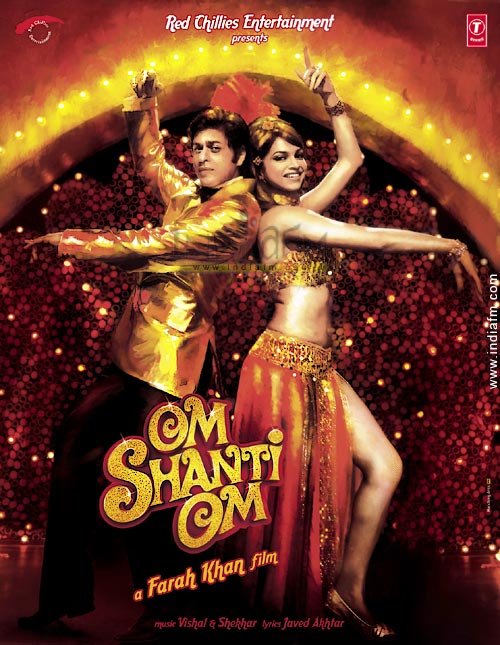 'Om Shanti Om', widely touted as the tribute to the kitschy cinema of the 1970s, features the re-union of SRK and Farah Khan after the hugely successful 'Main Hoon Naa'. SRK, a lot like Sreenivasan in 'Udayananu Tharam', plays a supremely untalented junior artist who wants to make it big. And make no mistake, this is a role tailor-made for the trademark mannerisms of SRK the star (as opposed to the actor, who reigned supreme with effective performances in 'Swades' and 'Chak De') - the stammer, the arched quirky eyebrows and the omnipresent hamming rather make sense in a movie like this, really. And his bubblegum-chewing modern star-son act, though irritating, hits the mark all too well - I mean, I can all too well imagine a Fardeen Khan or Tushaar Kapoor doing the same things!
However, I have to admit that I very much preferred the cheeky 'Main Hoon Naa' to this bloated, bursting-at-the-seams star vehicle. Yes, OSO does have some great in jokes (my personal favorites are the by-now-infamous Manoj Kumar sequence, the throwaway Govinda bit and of course the delightful 'Maine Pyar Kiya' reference), the awesome spoof on Filmfare awards, and also features the original 'Om Shanti Om' song sequence from one of the greatest masala potboilers of Hindi cinema ever. However, it also has a rather boring plot, inadequate music (despite the catchy six-pack ditty), an over-hyped 31-star song where one is forced to hear (for the first and probably only time ) admiring oohs when the likes of Arbaaz Khan, Sunil Shetty, Dino Morea etc enter the frame, and worst of all, a complete letdown of a climax 'inspired' from the above-mentioned 'Karz' (and another classic too, revealing the name of which would probably spoil what little novelty the climaz holds). 'MHN' managed to pay the same kind of homage, with a lot more tongue-firmly-in-cheek humor, and more importantly, without the conceit and pomp associated with this film.
The supporting cast comprises chiefly of the delightful Kiron Kher (who does the melodramatic Nirupa Roy kind-of role with just that amount of cheesiness), the under-utilized Shreyas Deshpande, and the surprisingly-sleazy-looking Arjun Ramphal (who, judging by his past few films, has firmly hitched onto the SRK bandwagon to make hay even while the sun does not shine). Deepika Padukone looks fantastic, and emotes well with what little she is entrusted with. Farah Khan's song picturizations are, surprisingly, lackluster. She has been claiming in quite a few interviews that conventional Bollywood choreography bores her nowadays, and believe me, the dis-interest shows. However, the rest of the film is super-grand technically, visually and aesthetically.
What does Farah Khan do next, though? She already has two films that pay homage to the bygone era of Bollywood, and appears to have exhausted the nostalgia factor. The litmus test for her would be whether she can make a completely different film next time - a whodunit perhaps?
Thoovanathumbikal: Poetry on Celluloid
Recently, I came across a beautiful piece on one of Padmarajan's oft discussed 'Thoovanathumbikal' on the Passion for Cinema blog. As the writer puts it, this is most definitely a movie that grows on you - disturbed characters, the use of symbols, and most of all, the loneliness that is the mark of the three principal characters make for some really compelling cinema. Indeed, there are not many directors who can convert literature to cinema so convincingly.
Here is the link to the piece - its worth your while. And this is something that I wrote last year about my favorite Padmarajan movies.
Here is the link to the piece - its worth your while. And this is something that I wrote last year about my favorite Padmarajan movies.
Friday, November 16, 2007
The Tehelka Expose
Tehelka has done it again - another expose, this time targeting the Gujarat genocide. And of course, we have the familiar litany of accusations, escapes and counter-attacks: why now, what about Godhra, what about 1984 and Rajiv Gandhi, pseudo-secular, pseudo-intellectual...the list is pretty long.
Actually, I have never understood this pseudo nonsense. It means 'False or Counterfeit' as far as I know, but I don't understand how opposing vehemently the rabid pro-Hinduvta brigade make one pesudo-something. That's another word I hate, Hinduvta - it is, to me, the complete antithesis of Hinduism, which is a word I have always associated with peace and tolerance. Hinduvta, on the other hand, reminds me of riots, murder, rape and now, - most horrifying of all - saffron draped men ripping out foetuses from pregnant mothers. Its barbaric that many of us equate one with the other, truly.
I am not sure whether this is, as Tehelka claims, the most remarkable story of our times. I mean, this was mostly just verification of something we already knew in the back of our minds - unlike, say, the extent of the cricket-bookies nexus. Nor do I care if they were, as their accusers frequently claim, politically motivated - that is irrelevant to the content of the story. We actually have murderers and rapists bragging about what they did on camera, with no show of remorse.
Will the judiciary shed its customary lethargy and take action? Or are we still reduced to online petitions and replying to 'action-reaction' quotes? Will Modi be voted back to power yet again like last time, based on his 'economic reforms'? If so, I fear what I read recently is true: we are no longer a civilization, merely an economy.
Actually, I have never understood this pseudo nonsense. It means 'False or Counterfeit' as far as I know, but I don't understand how opposing vehemently the rabid pro-Hinduvta brigade make one pesudo-something. That's another word I hate, Hinduvta - it is, to me, the complete antithesis of Hinduism, which is a word I have always associated with peace and tolerance. Hinduvta, on the other hand, reminds me of riots, murder, rape and now, - most horrifying of all - saffron draped men ripping out foetuses from pregnant mothers. Its barbaric that many of us equate one with the other, truly.
I am not sure whether this is, as Tehelka claims, the most remarkable story of our times. I mean, this was mostly just verification of something we already knew in the back of our minds - unlike, say, the extent of the cricket-bookies nexus. Nor do I care if they were, as their accusers frequently claim, politically motivated - that is irrelevant to the content of the story. We actually have murderers and rapists bragging about what they did on camera, with no show of remorse.
Will the judiciary shed its customary lethargy and take action? Or are we still reduced to online petitions and replying to 'action-reaction' quotes? Will Modi be voted back to power yet again like last time, based on his 'economic reforms'? If so, I fear what I read recently is true: we are no longer a civilization, merely an economy.
Sunday, October 07, 2007
My Favorite Film Song Videos
Admittedly, the idea for the post is borrowed from an old Naachgaana poll, and also from one of Qalandar's recent posts, the main difference here being that I am not sticking to Hindi movies, except for the exceptional ones. Here they are, some of my favorite film song videos, in no particular order.
Ek Ladki ko.. from 1942: A Love Story
RD Burman's swansong, and a great video befitting the sheer magic of the song. Manisha looked almost ethereal here; in fact, let me go out on a limb, and say that there's never been a song where a heroine has looked as beautiful. Moreover, Kumar Sanu, thankfully, has curbed his nasal instincts here. The fact that R.D.Burman had been out of sorts for a long while, and that he seemed to have conjured up a score on par with his best (and that's saying a lot) just before his demise contributes to the legend of this song too. Its an instant classic.
Narumugaye... from 'Iruvar'
Mani Ratnam was one of the first Indian directors who made the filming of songs a work of art. Prior to Ratnam, picturizing a song simply meant a dozen costume changes for the hero & heroine, a dozen skimpily clad women in the backdrop shaking their asses, and more often than not, a passing shower to conveniently drench the heroine. The advent of Ratnam and like-minded directors changed all that to a large extent. 'Iruvar' (The Duo), although a cropper at the B.O, is generally acknowledged as Ratnam's best work till date, and a milestone in Mohanlal's career - and considering the body of work both these thespians have built up, that's a truly remarkable. This song shows how serene, indeed how tranquil, B&W songs can be if done the right way. The song also builds up the relationship between Anandan (Mohanlal) and Pushpa (Aishwarya Rai, in her debut vehicle, and also probably her best performance till date), at the same time establishing the era of film-making using the shooting of the film-song.
Kanneer Poovinte... from 'Kireedom'
If ever there was a heartrending movie, then this is it. Narrating the tale of a son whose life goes astray after he is forced to take cudgels on his father's behalf, 'Kireedom' (Crown) brings a lump to the throat of anyone who has seen the movie, for its characters are so endearing, indeed so ordinary, that one cannot but help commiserate with them when theirs lives unravel. Remade in Hindi as 'Gardish' and in Tamil by the same name, a single telling glance by Mohanlal in this song (when his fiancee is being married off to another) easily outclasses entire performances by the other actors.
Sundari Neeyum... from 'MMKR'
MMKR, undoubtedly one of the best products of the Singeetham-Kamal-Crazy combination, is also one of the strongest contenders for the funnest Indian movies of all-time. It features the awesome track Sundari Neeyum... composed by Ilaiyaraja and sung by Kamal himself (in another language- Malayalam, to boot), with astounding vocal control. Contrary to public perception, this (and not Farah Khan's Pehla Nasha...) is the first song to be filmed entirely in slow-motion. Kamal's and Urvasi's characters here (Kameswaran and Tirupu Sundari, respectively) are incredibly endearing, and the whole song captures their simple dreams so well.
Devasabhathalam... from 'His Highness Abdullah'
'His Highness Abdullah' marked Mohanlal's entry into film production. It was a light-hearted movie that is still fondly remembered for its music, and a wonderful performance by Nedumudi Venu. The music, which is still fondly remembered, was by the brilliant music director Raveendran, fondly and reverentially refered as Raveendran-maashu. Each song in this movie is special, not least for the ease with which Mohanlal enacted them on screen. Not many actors can perform Carnatic / Hindustani songs convincingly on screen, and among the ones who can, Mohanlal easily rules the roost (for 'Morning Raaga', Shabana Azmi used to see this movie and 'Bharatham' as references). In fact, I am pretty sure that Priyadarsan has not copied this movie only because there are not many actors who can carry off songs like these. In this particular song, Mohanlal unwillingly clashes against a musical maestro (played by lyricist Kaithapram) in an awesome raagamalika.
Pachai Niramae... from 'Alaipayuthey'
A Mani Ratnam video again. Here, the picturization mimics the colorful lyrics in what is a virtual explosion of colors. Shaad Ali's 'Saathiya' mimicked the dance steps and the tune alright, but not the seamless union of lyrics and camera work that this video so effortlessly managed.
Maanam Thelinje Ninnal... from 'Thenmavin Kombathu'
This video is probably Priyadarsan's 'tribute' to some obscure Rajasthani folk song, but it works, and how! The catchy song (which owes its remixed existence to an old Ilaiyaraja tune), the sets and the awesome cinematography all contribute to this song being one of the best-shot Malayalam film songs.
Eeran Megham... from 'Chithram'
'Chithram' was probably the picture that catapulted Mohanlal to superstardom. This romantic tragedy directed by Priyadarsan ran for more than a year in Kerala, and made Mohanlal, who was until then merely popular, the heartthrob of thousands of women in Kerala. I know - looking at him today, it seems a little far-fetched to associate 'heartthrob' and Mohanlal in the same sentence. But take a look at him prancing around like the best of them in this song, and you'd know why. The girl in this song is Priyadarshan's wife today.
Chaiyya Chaiyya... from 'Dil Se'
Looking at it analytically, this is quite a dumb video - I mean, you have bunch of dancers dressed in what looks like Gujju attire grooving to a Punjabi song on a train that is going to Ooty. But then, the brains behind this song - Mani Ratnam, A.R Rahman, Gulzar , Sukhwinder Singh, Farah Khan and SRK - were at a crescendo of sorts, and their confidence / energy / adrenaline somehow seeps through into the song. Truly, even after listening / viewing the song umpteen times, even today, it gets your feet tapping. That is the magic of cinema for you.
Theme from 'Punnagai Mannan'
An outstanding BGM composed by maestro Ilaiyaraja, played on the keyboard by none other than A.R Rahman, and featuring the muti-faceted Kamal Hasan on screen, its no wonder that this 2-minute bit of music still lives on thru ringtones and mobile phones. Kamal Hasan, a trained classical dancer, apparently had a hard time getting the Western dance moves here, and had to undergo a lot of training and practice. Well, the results show!
Sundari... from 'Dalapathi'
This song features one of the best war sequences Indian cinema has ever seen, albeit in a setting reminiscent of the Japanese Samurai. Likening Surya's code of honor to that of the Samurai might be Mani's way of glorifying superstar Rajni in a movie that is remarkably short of Rajni's usual mannerisms. The evergreen tale of the king at war, and his beautiful queen who waits for him is the theme here, and Mani handles it beautifully. Moreover, the whole song is shot in the golden hues of sunrise or sunset, befitting a re-telling of the legend of Karna, son of the sun-god.
On a lighter note, poor Rajni's various hairstyles in this song must have contributed in no small vein to his current bald condition!
Kanmani... from 'Guna'
The tale of the deranged Guna who kidnaps his Abhirami could not make a dent at the the box-office. However, a decade later, the movie and its music is hailed as a classic. The other awesome BGM piece from the same movie almost edged out another entry in this list. The almost maniacal love that Guna exhibits toward his prisoner, and his claims that his love is so pure that is almost holy are all accentuated by the lyrics, Ilaiyaraja's tune and BGM, and of course, Kamal's acting. The entire song is about the girl setting tune to Kamal's verse, a concept that has been done before, but never to such spectacular effect.
Ek Ladki ko.. from 1942: A Love Story
RD Burman's swansong, and a great video befitting the sheer magic of the song. Manisha looked almost ethereal here; in fact, let me go out on a limb, and say that there's never been a song where a heroine has looked as beautiful. Moreover, Kumar Sanu, thankfully, has curbed his nasal instincts here. The fact that R.D.Burman had been out of sorts for a long while, and that he seemed to have conjured up a score on par with his best (and that's saying a lot) just before his demise contributes to the legend of this song too. Its an instant classic.
Narumugaye... from 'Iruvar'
Mani Ratnam was one of the first Indian directors who made the filming of songs a work of art. Prior to Ratnam, picturizing a song simply meant a dozen costume changes for the hero & heroine, a dozen skimpily clad women in the backdrop shaking their asses, and more often than not, a passing shower to conveniently drench the heroine. The advent of Ratnam and like-minded directors changed all that to a large extent. 'Iruvar' (The Duo), although a cropper at the B.O, is generally acknowledged as Ratnam's best work till date, and a milestone in Mohanlal's career - and considering the body of work both these thespians have built up, that's a truly remarkable. This song shows how serene, indeed how tranquil, B&W songs can be if done the right way. The song also builds up the relationship between Anandan (Mohanlal) and Pushpa (Aishwarya Rai, in her debut vehicle, and also probably her best performance till date), at the same time establishing the era of film-making using the shooting of the film-song.
Kanneer Poovinte... from 'Kireedom'
If ever there was a heartrending movie, then this is it. Narrating the tale of a son whose life goes astray after he is forced to take cudgels on his father's behalf, 'Kireedom' (Crown) brings a lump to the throat of anyone who has seen the movie, for its characters are so endearing, indeed so ordinary, that one cannot but help commiserate with them when theirs lives unravel. Remade in Hindi as 'Gardish' and in Tamil by the same name, a single telling glance by Mohanlal in this song (when his fiancee is being married off to another) easily outclasses entire performances by the other actors.
Sundari Neeyum... from 'MMKR'
MMKR, undoubtedly one of the best products of the Singeetham-Kamal-Crazy combination, is also one of the strongest contenders for the funnest Indian movies of all-time. It features the awesome track Sundari Neeyum... composed by Ilaiyaraja and sung by Kamal himself (in another language- Malayalam, to boot), with astounding vocal control. Contrary to public perception, this (and not Farah Khan's Pehla Nasha...) is the first song to be filmed entirely in slow-motion. Kamal's and Urvasi's characters here (Kameswaran and Tirupu Sundari, respectively) are incredibly endearing, and the whole song captures their simple dreams so well.
Devasabhathalam... from 'His Highness Abdullah'
'His Highness Abdullah' marked Mohanlal's entry into film production. It was a light-hearted movie that is still fondly remembered for its music, and a wonderful performance by Nedumudi Venu. The music, which is still fondly remembered, was by the brilliant music director Raveendran, fondly and reverentially refered as Raveendran-maashu. Each song in this movie is special, not least for the ease with which Mohanlal enacted them on screen. Not many actors can perform Carnatic / Hindustani songs convincingly on screen, and among the ones who can, Mohanlal easily rules the roost (for 'Morning Raaga', Shabana Azmi used to see this movie and 'Bharatham' as references). In fact, I am pretty sure that Priyadarsan has not copied this movie only because there are not many actors who can carry off songs like these. In this particular song, Mohanlal unwillingly clashes against a musical maestro (played by lyricist Kaithapram) in an awesome raagamalika.
Pachai Niramae... from 'Alaipayuthey'
A Mani Ratnam video again. Here, the picturization mimics the colorful lyrics in what is a virtual explosion of colors. Shaad Ali's 'Saathiya' mimicked the dance steps and the tune alright, but not the seamless union of lyrics and camera work that this video so effortlessly managed.
Maanam Thelinje Ninnal... from 'Thenmavin Kombathu'
This video is probably Priyadarsan's 'tribute' to some obscure Rajasthani folk song, but it works, and how! The catchy song (which owes its remixed existence to an old Ilaiyaraja tune), the sets and the awesome cinematography all contribute to this song being one of the best-shot Malayalam film songs.
Eeran Megham... from 'Chithram'
'Chithram' was probably the picture that catapulted Mohanlal to superstardom. This romantic tragedy directed by Priyadarsan ran for more than a year in Kerala, and made Mohanlal, who was until then merely popular, the heartthrob of thousands of women in Kerala. I know - looking at him today, it seems a little far-fetched to associate 'heartthrob' and Mohanlal in the same sentence. But take a look at him prancing around like the best of them in this song, and you'd know why. The girl in this song is Priyadarshan's wife today.
Chaiyya Chaiyya... from 'Dil Se'
Looking at it analytically, this is quite a dumb video - I mean, you have bunch of dancers dressed in what looks like Gujju attire grooving to a Punjabi song on a train that is going to Ooty. But then, the brains behind this song - Mani Ratnam, A.R Rahman, Gulzar , Sukhwinder Singh, Farah Khan and SRK - were at a crescendo of sorts, and their confidence / energy / adrenaline somehow seeps through into the song. Truly, even after listening / viewing the song umpteen times, even today, it gets your feet tapping. That is the magic of cinema for you.
Theme from 'Punnagai Mannan'
An outstanding BGM composed by maestro Ilaiyaraja, played on the keyboard by none other than A.R Rahman, and featuring the muti-faceted Kamal Hasan on screen, its no wonder that this 2-minute bit of music still lives on thru ringtones and mobile phones. Kamal Hasan, a trained classical dancer, apparently had a hard time getting the Western dance moves here, and had to undergo a lot of training and practice. Well, the results show!
Sundari... from 'Dalapathi'
This song features one of the best war sequences Indian cinema has ever seen, albeit in a setting reminiscent of the Japanese Samurai. Likening Surya's code of honor to that of the Samurai might be Mani's way of glorifying superstar Rajni in a movie that is remarkably short of Rajni's usual mannerisms. The evergreen tale of the king at war, and his beautiful queen who waits for him is the theme here, and Mani handles it beautifully. Moreover, the whole song is shot in the golden hues of sunrise or sunset, befitting a re-telling of the legend of Karna, son of the sun-god.
On a lighter note, poor Rajni's various hairstyles in this song must have contributed in no small vein to his current bald condition!
Kanmani... from 'Guna'
The tale of the deranged Guna who kidnaps his Abhirami could not make a dent at the the box-office. However, a decade later, the movie and its music is hailed as a classic. The other awesome BGM piece from the same movie almost edged out another entry in this list. The almost maniacal love that Guna exhibits toward his prisoner, and his claims that his love is so pure that is almost holy are all accentuated by the lyrics, Ilaiyaraja's tune and BGM, and of course, Kamal's acting. The entire song is about the girl setting tune to Kamal's verse, a concept that has been done before, but never to such spectacular effect.
Thursday, October 04, 2007
Arabikatha: Review
It was not that long ago that I lamented the apparent demise of Sreenivasan's talent. To the discerning viewer, his steady descent into mediocrity has been not only been alarming, but also more than a little sad. But with Arabikatha, Sreenivasan proves that there are still avenues that he has not explored as an actor.
It has been a long time since Malayalam cinema has seen a good political movie. By 'good', I mean sensible movies that attempt to address real issues with a semblance of sense, not the ones where the so-called superstars spout pages of dialogue, often laced with expletives in multiple languages. To Venu Nagavalli's splendid 'Lal Salaam' and the Sathyan-Sreeni combo's delightful 'Sandesham', we can now add Lal Jose's 'Arabikatha' too.
'Cuba' Mukundan (Sreenivasan) is an earnest Communist party-worker , whose life is completely in tune with the ideologies preached by the party. His earnestness, however, ruffles the feathers of industrial bigwig Kunjunni (Jagathy, in yet another 'avatar') and upcoming part leader Karunan. Mukundan's naiveness makes him an easy target, and against his misgivings, he is forced to leave for Dubai. Arabikatha traces the journey of Mukundan from here on.
Dubai tests Mukundan in a way nothing in his hitherto life has prepared him for. Bourgeois CEOs call the shots here, and working / living conditions are pathetic. There is not much scope for protests either, as Mukundan finds out the hard way. Misled by friends, and cheated by the ones he comes to depend on, Mukundan learns the lessons of life the hard way. Three years later, the premature grey in Mukundan's moustache hints at the kind of hardships he has had to endure. A rather botched-up climax later, all's well that ends well, as they say.
Sreenivasan is the life and soul of this movie. There are the trademark digs at the Malayali's psyche, and a couple at the outdated ideologies of the Communist movement, yes. But what sets this performance apart from his latest ventures is that there is no attempt at buffoonery of any kind. Sreenivasan plays Mukundan straight, shorn of all his usual mannerisms, and comes out with what probably is a career-best performance. Toward the end, the amount of weariness and worldly wisdom he conveys is just right, and one can't help but root for the protagonist.
Lal Jose, along with Blessy, is one of the few filmmakers who's name carries with it the assurance of good cinema ('Rasikan' and 'Pattalam' were but minor aberrations, hopefully). He doesn't let one down here either. Great placement of scenes, a complete avoidance of slapstick comedy (though I wish he'd avoided Salim Kumar too, he's a misfit in the proceedings here), and most of all, the brilliance of casting Sreenivasan in the title role when a 'safe' choice like Jayaram / Dileep would have worked at the B.O too - all these aspects deserve praise of the highest order. Lal Jose is one of the few directors who's been successful in creating successfull and good commercial cinema without resorting to the 2 Ms, and he succeeds on all fronts here too. 'Arabikatha' is another feather in his cap.
Verdict: Eminently watchable.
It has been a long time since Malayalam cinema has seen a good political movie. By 'good', I mean sensible movies that attempt to address real issues with a semblance of sense, not the ones where the so-called superstars spout pages of dialogue, often laced with expletives in multiple languages. To Venu Nagavalli's splendid 'Lal Salaam' and the Sathyan-Sreeni combo's delightful 'Sandesham', we can now add Lal Jose's 'Arabikatha' too.
'Cuba' Mukundan (Sreenivasan) is an earnest Communist party-worker , whose life is completely in tune with the ideologies preached by the party. His earnestness, however, ruffles the feathers of industrial bigwig Kunjunni (Jagathy, in yet another 'avatar') and upcoming part leader Karunan. Mukundan's naiveness makes him an easy target, and against his misgivings, he is forced to leave for Dubai. Arabikatha traces the journey of Mukundan from here on.
Dubai tests Mukundan in a way nothing in his hitherto life has prepared him for. Bourgeois CEOs call the shots here, and working / living conditions are pathetic. There is not much scope for protests either, as Mukundan finds out the hard way. Misled by friends, and cheated by the ones he comes to depend on, Mukundan learns the lessons of life the hard way. Three years later, the premature grey in Mukundan's moustache hints at the kind of hardships he has had to endure. A rather botched-up climax later, all's well that ends well, as they say.
Sreenivasan is the life and soul of this movie. There are the trademark digs at the Malayali's psyche, and a couple at the outdated ideologies of the Communist movement, yes. But what sets this performance apart from his latest ventures is that there is no attempt at buffoonery of any kind. Sreenivasan plays Mukundan straight, shorn of all his usual mannerisms, and comes out with what probably is a career-best performance. Toward the end, the amount of weariness and worldly wisdom he conveys is just right, and one can't help but root for the protagonist.
Lal Jose, along with Blessy, is one of the few filmmakers who's name carries with it the assurance of good cinema ('Rasikan' and 'Pattalam' were but minor aberrations, hopefully). He doesn't let one down here either. Great placement of scenes, a complete avoidance of slapstick comedy (though I wish he'd avoided Salim Kumar too, he's a misfit in the proceedings here), and most of all, the brilliance of casting Sreenivasan in the title role when a 'safe' choice like Jayaram / Dileep would have worked at the B.O too - all these aspects deserve praise of the highest order. Lal Jose is one of the few directors who's been successful in creating successfull and good commercial cinema without resorting to the 2 Ms, and he succeeds on all fronts here too. 'Arabikatha' is another feather in his cap.
Verdict: Eminently watchable.
Sunday, September 09, 2007
Friday, September 07, 2007
RGV Ki Aag: Review
'RGV Ki Aag' is not merely Sholay desecrated upon; it also marks the decline of RGV the director, who used to be rubbing shoulders with our finest. But with the soulless Nishabd and worse, the insipid Aag, one is left yearning for the director who gave us such gems as Satya and Company. Comparisons with the evergreen classic apart, Aag fails even as a solitary venture.
Nisha Kothari - whose ass hogs a major chunk of the movie, second only to Bachchan's ugly mug - displays such abominable acting abilities whenever she has a scene that you yearn for the camera to shift to her assets instead - this is one aspect of RGV's direction I just cannot criticize, for anything is better than seeing her try hard to enact the ebullient persona of Basanti that Hema Malini, for all her limited acting skills, made her own. The wisest career decision she could make is to shift to porn movies, since that's all she's cast for in normal movies anyhow.
Marks: 0/10 (Was tempted to give her a 0.5 for the skin-display, but...)
Sushmita Sen, who replaces Jaya Bhaduri, does try hard - too hard, in fact. However, her part is too noble and self-righteous to make one sympathise with her. The lovely romantic angle between Bachchan and her in the original is mutilated by RGV here, and its carcass is then burnt with petrol, and the ashes are then flushed away... you get the picture. It is to Sushmita's credit that she never goes overboard, thank heavens for small mercies.
Marks: 3/10
Urmila, never far away from RGV's couch, sorry cast, is thankfully relegated to the Mehbooba number. The oomph factor is fading fast, its probably time for her to hang up her boots and get married. And WTF was RGV thinking of when he weaved in that inane Kabhi Kabhi bit, and then the flirtation between her and Babban? The man needs a reality check, and fast.
Marks: 1/10
Ajay Devgun, who has a reputation of being one of Bollywood's more reliable actors, does his cause no good here. He has no comic ability to speak of, and was never strong on charm anyhow. Consequently, he is one of the biggest misfits in the movie. The roguish charm that so endeared Dharam's Veeru to us is completely absent here. He has no chemistry with his partner at all, and consequently their friendship is a yawn. All he does well here is ogle Nisha's boobs, and touch her up. And please, Ajay, drag your ass to a dentist and get your gutka-covered teeth cleaned.
Marks: 1/10
Prashant Raj, who gets to replace Bachchan, has only two things in common with his illustrious predecessor, and those are his long legs. He's got a nice deep voice too, but two legs and a semi-baritone doth not an actor make. Hope he catches the next flight to Los Angeles!
Marks: 1/10 (gets 1 only because he is not as annoying as Kothari).
Rajpal Yadav, whose annoying high-pitched cackle makes you want to thrown him down a well, would do better not to accept such inane stuff. He is a rather decent actor, and it is a shame watching him throw it away.
Marks: 1/10 (again, gets a 1 sorely when compared to Nisha)
Sushant Singh can consider his debt to RGV (for Jungle) repaid with interest. He tries his hardest to exude menace, and might even have succeeded if he had a couple of scenes to himself. But alas, RGV is too infatuated with the legend of Gabbar to even consider granting some footage to other actors.
Marks: 2/10
Mohanlal is one of the few sane things in the movie. The flashback with him is the one credible sequence in the movie, and his scenes with Bachchan crackle with electricity. He manages to infuse some semblance of dignity to the proceedings whenever he is on screen, despite the terrible accent. Whoever had the bright idea that Mohanlal should have that stupid beard (he had no fingers you know, hence he couldn't shave), thank god he didn't think of how he would wash his bum after taking a shit. Despite hackneyed dialogue, bad makeup, a terrible Holi song where he is actually made to dance like a woman, and very little footage, he is easily the best thing about this movie.
Marks: 5/10
Bachchan, who is toward the fag end of his illustrious career, hams like a crazy coot. He hisses, cackles, rolls his eyes menacingly, guffaws with menace, drones on about America and Iraq, and even digs his nose. Well, with the kind of shoddy performance he's put in here, even scratching his balls or even the crevice of his ass wouldn't have helped. This is a textbook as to how Gabbar ought not to have been played - the performance, if you can call it that, is much more suited for a children's movie. All the makeup in the world - the fuss about the different colored eyes, or the scarred nose - cannot disguise a shockingly bad performance from Bachchan. The one thing he gets right is when his eyes, otherwise dull, light up when he gets a new victim to torture / kill, in keeping with the attempted sociopath personality. No menace, no fear, no acting chops.
Marks: 1/10
RGV gets everything wrong here, whether its controlling the overacting Big B, granting some decent footage to the few actors who do their job well, or at least maintaining some decorum to the proceedings. He, along with Bachchan and Urmila, is also singularly responsible for defiling one of the most beautiful bits of poetry in Indian cinema ever. If he'd paid half the attention the the screenplay that he does to Kothari's ass out here, the movie might even have been watchable. Alas, it was not to be.
Marks: 0/10
Nisha Kothari - whose ass hogs a major chunk of the movie, second only to Bachchan's ugly mug - displays such abominable acting abilities whenever she has a scene that you yearn for the camera to shift to her assets instead - this is one aspect of RGV's direction I just cannot criticize, for anything is better than seeing her try hard to enact the ebullient persona of Basanti that Hema Malini, for all her limited acting skills, made her own. The wisest career decision she could make is to shift to porn movies, since that's all she's cast for in normal movies anyhow.
Marks: 0/10 (Was tempted to give her a 0.5 for the skin-display, but...)
Sushmita Sen, who replaces Jaya Bhaduri, does try hard - too hard, in fact. However, her part is too noble and self-righteous to make one sympathise with her. The lovely romantic angle between Bachchan and her in the original is mutilated by RGV here, and its carcass is then burnt with petrol, and the ashes are then flushed away... you get the picture. It is to Sushmita's credit that she never goes overboard, thank heavens for small mercies.
Marks: 3/10
Urmila, never far away from RGV's couch, sorry cast, is thankfully relegated to the Mehbooba number. The oomph factor is fading fast, its probably time for her to hang up her boots and get married. And WTF was RGV thinking of when he weaved in that inane Kabhi Kabhi bit, and then the flirtation between her and Babban? The man needs a reality check, and fast.
Marks: 1/10
Ajay Devgun, who has a reputation of being one of Bollywood's more reliable actors, does his cause no good here. He has no comic ability to speak of, and was never strong on charm anyhow. Consequently, he is one of the biggest misfits in the movie. The roguish charm that so endeared Dharam's Veeru to us is completely absent here. He has no chemistry with his partner at all, and consequently their friendship is a yawn. All he does well here is ogle Nisha's boobs, and touch her up. And please, Ajay, drag your ass to a dentist and get your gutka-covered teeth cleaned.
Marks: 1/10
Prashant Raj, who gets to replace Bachchan, has only two things in common with his illustrious predecessor, and those are his long legs. He's got a nice deep voice too, but two legs and a semi-baritone doth not an actor make. Hope he catches the next flight to Los Angeles!
Marks: 1/10 (gets 1 only because he is not as annoying as Kothari).
Rajpal Yadav, whose annoying high-pitched cackle makes you want to thrown him down a well, would do better not to accept such inane stuff. He is a rather decent actor, and it is a shame watching him throw it away.
Marks: 1/10 (again, gets a 1 sorely when compared to Nisha)
Sushant Singh can consider his debt to RGV (for Jungle) repaid with interest. He tries his hardest to exude menace, and might even have succeeded if he had a couple of scenes to himself. But alas, RGV is too infatuated with the legend of Gabbar to even consider granting some footage to other actors.
Marks: 2/10
Mohanlal is one of the few sane things in the movie. The flashback with him is the one credible sequence in the movie, and his scenes with Bachchan crackle with electricity. He manages to infuse some semblance of dignity to the proceedings whenever he is on screen, despite the terrible accent. Whoever had the bright idea that Mohanlal should have that stupid beard (he had no fingers you know, hence he couldn't shave), thank god he didn't think of how he would wash his bum after taking a shit. Despite hackneyed dialogue, bad makeup, a terrible Holi song where he is actually made to dance like a woman, and very little footage, he is easily the best thing about this movie.
Marks: 5/10
Bachchan, who is toward the fag end of his illustrious career, hams like a crazy coot. He hisses, cackles, rolls his eyes menacingly, guffaws with menace, drones on about America and Iraq, and even digs his nose. Well, with the kind of shoddy performance he's put in here, even scratching his balls or even the crevice of his ass wouldn't have helped. This is a textbook as to how Gabbar ought not to have been played - the performance, if you can call it that, is much more suited for a children's movie. All the makeup in the world - the fuss about the different colored eyes, or the scarred nose - cannot disguise a shockingly bad performance from Bachchan. The one thing he gets right is when his eyes, otherwise dull, light up when he gets a new victim to torture / kill, in keeping with the attempted sociopath personality. No menace, no fear, no acting chops.
Marks: 1/10
RGV gets everything wrong here, whether its controlling the overacting Big B, granting some decent footage to the few actors who do their job well, or at least maintaining some decorum to the proceedings. He, along with Bachchan and Urmila, is also singularly responsible for defiling one of the most beautiful bits of poetry in Indian cinema ever. If he'd paid half the attention the the screenplay that he does to Kothari's ass out here, the movie might even have been watchable. Alas, it was not to be.
Marks: 0/10
Monday, August 06, 2007
Sreenivasan: An Underrated Genius, But Past His Prime?
Recently, I made the mistake of watching a Mallu version of 'Analyze That', 'Bhargava Charitham 4-am Ghandam' starring Sreenivasan and Mammootty. To say that the move was terrible would be an understatement. Although the dialogues did bear a passing resemblance to the Sreenivasan of yore, most often they were not even remotely funny. One fears that in his zeal to show off his newfound comic skills, Mammooty is descending into alarming levels of mediocrity. Though he does try to top it off with a handful of sensible movies every year, doing such roles affects not only his image, but also his stature as an actor. As for Sreenivasan, he's become too old to carry off his unique brand of comedy any longer. And - why doesn't anyone get this - we DO NOT want to see 50-year old men dressed up in shorts, sleeveless shirts, and designer outfits - and this is not directed just at Mammootty either. Stuff the opulence, and give us a decent story, for chrissake!
Its really a pity that intelligent, 'thinking' cine-people like Sreenivasan fail to keep up with time, and come out with such nonsense. His screenplays were responsible for some of the landmark films of the 1980s, the golden period of Malayalam cinema. Indeed, looking back, Sreenivasan was pretty much to Malayalm cinema, what Hrishikesh Mukherjee was to Bollywood. Looking forward to better cinema from this underrated genius, here's a list of the movies why I regard him as one of the best talents of Malayalam cinema.
Varavelpu (Welcome): Notwithstanding other popular movies from the Sathyan Anthikkad - Mohanlal - Sreenivasan trio, this is most probably their best collaboration IMO. The script by Sreenivasan traces the journey of a Gulf-returned Mohanlal who tries hard to eke out a living in a Communist-infested Kerala by running a private bus. Laced with subtle humor, great all-round performances, and a tight screenplay that never veers too far from reality, this was a gem of a movie. Sadly, it is shortly to be remade in Hindi (read destroyed) by a Priyadarsan crony, with Govinda in the lead.
Vadakku Nokki Yanthram marked the directorial debut of Sreenivasan. Although the movie was interspersed with his characteristic self-effacing wit and deadpan dialogs, the tale of an average-looking guy with an inferiority complex getting married to a beautiful girl was Malayalam cinema's first intentional black comedy, and hit a chord with audiences everywhere. Sreenivasan, through his penchant for self-directed sarcasm and ridiculous situations, depicted the misgivings of an average man beautifully here. Main, Meri Pathni Aur Woh was directly inspired from this movie, and it boasted of a terrific performance by another supremely talented actor, Rajpal Yadav.
Nadodikattu (The Wandering Wind): When one talks of the Mohanlal-Sreenivasan combination, this would in all probability be the first movie that one remembers. The characters of this hilarious rags-to-riches tale - be it the innocent Dasan-Vijayan duo, the paranoid villain Ananthan Nambiar, Gafoorkka who runs a 'yatch' to the 'Gulf', or the hired killer Pavanayi - are still fresh in our minds, despite the movie being almost 3 decades old. This has Sreenivasan at his vintage best - the acerbic wit, the social commentary, and the dig at the typical Malayalee egotism are all there.
Sandesham (Message) was political satire at its best. Apart from the recent Vadivelu-starrer 'Imsai Arasan...' and the Kundan Shah classic 'Jaane Bhi Do Yaaron', I cannot recall a single political satire in our cinema (forgive me if I am not conversant with regional language cinema apart from Malayalam and Tamil). On the pretext of displaying oneupmanship between two brothers (who belong to rival political parties), Sreenivasan launches a scathing indictment on both the political parties of Kerala. Its a tremendously funny film, but nonetheless accurate and socially relevant too.
Chinthavishtayaya Shyamala (Thoughtful Shyamala) was Sreenivasan's second attempt at direction. Audience expectations were high after his acclaimed previous outing, and he didn't let them down either. The opening scene of the movie, where in a scathing indictment of Kerala's electricity board, the dialogue likens electricity to a stray cat, set the mood of the movie. It would perhaps be irreverent to suggest that the irresponsible husband is a manifestation of Lord Rama's inability/refusal to fulfil his responsibilities toward his wife, but the title of the movie certainly seems to slyly suggest so. The movie's harsh indictment of ashram-life at the expense of familiar responsibilities was another hint in this direction, IMO. Once again, the movie was a tremendous success at the BO, and critically acclaimed as well.
Thalayanamanthram (Feminine Wile) saw Sreenivasan take on the universal topic of envy and feminine wile. Urvashi puts in one of her best performances as the middle-class wife. It was to her credit that a character who could have easily come off as a shrew, was instead portrayed as a normal woman with her share of aspirations and failings. Urvashi displayed razor-edge control in not letting her character slip into farce. Unfortunately, it is this control that Urvashi seems to have lost, as can be seen in her recent outings like Achuvinte Amma, and more noticeably in Madhuchandralekha.
Vellanakalude Naadu (The Land of White Elephants) was directed by Priyadarsan at a time when he was still a competent director. Devoid of frills (save the hilarious crowd-pleasing bulldozer sequence), the movie narrates the plight of a road contractor (superbly enacted by Mohanlal) in Kerala. For a change, Sreenivasan plays a serious role - that of the diligent social worker whose family has been killed due to a bridge collapsing - and excels in it too. The Priyan - Mohanlal - Sreenivasan combo duplicated pretty much the same formula in Midhunam, but could not recreate the same magic.
Oru Maravathoor Kanavu (A Maravathoor Dream) had debutante director Lal Jose riding on the front of a powerful screenplay by Sreenivasan, and a bravura performance by Mammootty. However, it was evident that here was a skilled director who showed promise. In a departure from his earlier screenplays, Sreenivsan stepped away from the traditional Malayalam milieu, and built characters based on the TN-Kerala border. He also had Mammootty enact one his most successful comedic roles - his dialogues, with a sarcastic Christian tinge, were outstanding.
Udayananu Tharam (Udayan is the Star) does not hold a candle to the best works of Sreenivasan. However, the sarcasm here was directed at the bigwigs of the Malayalam film industry, and once again, that was a first. Sreenivsan took open digs at our superstars, be it at Mohanlal's business ventures, or Mammootty's penchant for dressing up in designer clothes. Most of his barbs, however, were directed at self-proclaimed superstar Dileep. This was venomous, and the audiences lapped it up. The movie is being remade in Tamil, and Hindi - how successful these remakes would be remain to be seen.
Its really a pity that intelligent, 'thinking' cine-people like Sreenivasan fail to keep up with time, and come out with such nonsense. His screenplays were responsible for some of the landmark films of the 1980s, the golden period of Malayalam cinema. Indeed, looking back, Sreenivasan was pretty much to Malayalm cinema, what Hrishikesh Mukherjee was to Bollywood. Looking forward to better cinema from this underrated genius, here's a list of the movies why I regard him as one of the best talents of Malayalam cinema.
Varavelpu (Welcome): Notwithstanding other popular movies from the Sathyan Anthikkad - Mohanlal - Sreenivasan trio, this is most probably their best collaboration IMO. The script by Sreenivasan traces the journey of a Gulf-returned Mohanlal who tries hard to eke out a living in a Communist-infested Kerala by running a private bus. Laced with subtle humor, great all-round performances, and a tight screenplay that never veers too far from reality, this was a gem of a movie. Sadly, it is shortly to be remade in Hindi (read destroyed) by a Priyadarsan crony, with Govinda in the lead.
Vadakku Nokki Yanthram marked the directorial debut of Sreenivasan. Although the movie was interspersed with his characteristic self-effacing wit and deadpan dialogs, the tale of an average-looking guy with an inferiority complex getting married to a beautiful girl was Malayalam cinema's first intentional black comedy, and hit a chord with audiences everywhere. Sreenivasan, through his penchant for self-directed sarcasm and ridiculous situations, depicted the misgivings of an average man beautifully here. Main, Meri Pathni Aur Woh was directly inspired from this movie, and it boasted of a terrific performance by another supremely talented actor, Rajpal Yadav.
Nadodikattu (The Wandering Wind): When one talks of the Mohanlal-Sreenivasan combination, this would in all probability be the first movie that one remembers. The characters of this hilarious rags-to-riches tale - be it the innocent Dasan-Vijayan duo, the paranoid villain Ananthan Nambiar, Gafoorkka who runs a 'yatch' to the 'Gulf', or the hired killer Pavanayi - are still fresh in our minds, despite the movie being almost 3 decades old. This has Sreenivasan at his vintage best - the acerbic wit, the social commentary, and the dig at the typical Malayalee egotism are all there.
Sandesham (Message) was political satire at its best. Apart from the recent Vadivelu-starrer 'Imsai Arasan...' and the Kundan Shah classic 'Jaane Bhi Do Yaaron', I cannot recall a single political satire in our cinema (forgive me if I am not conversant with regional language cinema apart from Malayalam and Tamil). On the pretext of displaying oneupmanship between two brothers (who belong to rival political parties), Sreenivasan launches a scathing indictment on both the political parties of Kerala. Its a tremendously funny film, but nonetheless accurate and socially relevant too.
Chinthavishtayaya Shyamala (Thoughtful Shyamala) was Sreenivasan's second attempt at direction. Audience expectations were high after his acclaimed previous outing, and he didn't let them down either. The opening scene of the movie, where in a scathing indictment of Kerala's electricity board, the dialogue likens electricity to a stray cat, set the mood of the movie. It would perhaps be irreverent to suggest that the irresponsible husband is a manifestation of Lord Rama's inability/refusal to fulfil his responsibilities toward his wife, but the title of the movie certainly seems to slyly suggest so. The movie's harsh indictment of ashram-life at the expense of familiar responsibilities was another hint in this direction, IMO. Once again, the movie was a tremendous success at the BO, and critically acclaimed as well.
Thalayanamanthram (Feminine Wile) saw Sreenivasan take on the universal topic of envy and feminine wile. Urvashi puts in one of her best performances as the middle-class wife. It was to her credit that a character who could have easily come off as a shrew, was instead portrayed as a normal woman with her share of aspirations and failings. Urvashi displayed razor-edge control in not letting her character slip into farce. Unfortunately, it is this control that Urvashi seems to have lost, as can be seen in her recent outings like Achuvinte Amma, and more noticeably in Madhuchandralekha.
Vellanakalude Naadu (The Land of White Elephants) was directed by Priyadarsan at a time when he was still a competent director. Devoid of frills (save the hilarious crowd-pleasing bulldozer sequence), the movie narrates the plight of a road contractor (superbly enacted by Mohanlal) in Kerala. For a change, Sreenivasan plays a serious role - that of the diligent social worker whose family has been killed due to a bridge collapsing - and excels in it too. The Priyan - Mohanlal - Sreenivasan combo duplicated pretty much the same formula in Midhunam, but could not recreate the same magic.
Oru Maravathoor Kanavu (A Maravathoor Dream) had debutante director Lal Jose riding on the front of a powerful screenplay by Sreenivasan, and a bravura performance by Mammootty. However, it was evident that here was a skilled director who showed promise. In a departure from his earlier screenplays, Sreenivsan stepped away from the traditional Malayalam milieu, and built characters based on the TN-Kerala border. He also had Mammootty enact one his most successful comedic roles - his dialogues, with a sarcastic Christian tinge, were outstanding.
Udayananu Tharam (Udayan is the Star) does not hold a candle to the best works of Sreenivasan. However, the sarcasm here was directed at the bigwigs of the Malayalam film industry, and once again, that was a first. Sreenivsan took open digs at our superstars, be it at Mohanlal's business ventures, or Mammootty's penchant for dressing up in designer clothes. Most of his barbs, however, were directed at self-proclaimed superstar Dileep. This was venomous, and the audiences lapped it up. The movie is being remade in Tamil, and Hindi - how successful these remakes would be remain to be seen.
Saturday, July 28, 2007
Big B, Vinodayathra: Review
 'Big B' reads almost like a James Hadley Chase novel - I mean, a renegade gang of orphans set out to get their revenge against the murderer of their surrogate mom, is typically something that Chase, Lee Child or even Louis L'Amour would write. D'ebutant director Amal Neerad is obviously inspired by his mentor RGV, at least insofar as technique is concerned. However, the premise of the movie is as stale as they come.
Social worker Nafisa Ali is brutally murdered on the streets of Kochi, murkier than the Mumbai of RGV's 'Satya'. Four of the many street urchins she has helped nurture are determined to avenge her death. Leading them is Bilal, the Big B, a dark, brooding killer who is apt only to mumble - that too in monosyllables. The role doesn't ask much of Mammootty, merely his best impersonation of Ajay Devgan. For while, the movie promises an interesting twist, but soon meanders off to the archetypal good vs. evil finale, where good overpowers evil, and all is well again.
As noted earlier, the basic good vs evil theme is certainly redundant, and there is nothing remarkable about the performances either (although a couple of the newcomers are endearing, and show promise). What eventually saves the movie is the fresh directorial style of Amal Neerad. From the way the shots have been framed, to the song picturizations and fights, the director leaves no stone unturned to showcase his capabilities. The dialogues are crisp - and for a change there are no Sanskrit hymns in the background, nor does the hero spout endless pages of dialogue in English, Sanskrit, Hindi etc. Things are kept simple, and in the end its a decent outing that at least doesn't make one cringe.

Sathyan Anthikkad, veteran film-maker, teams up with aspiring superstar Dileep to churn out yet another sample of his brand of feel-good cinema, named 'Vinodayathra' (Picnic) this time. Stale theme, lacklustre direction, terrible song picturizations, music that ranges from bad to okay - this movie showcases all that is wrong with today's Malayalam cinema.
Dileep, in yet another variation of his boy-next-door persona, is a wayward MCA graduate, who is irresponsible, irritating and exasperating all at once. One feels for his brother-in-law (a splendid Mukesh), who is forced to house Dileep. Of course, Meera Jasmine plays one of those do-gooder girls who, despite numerous setbacks (and I do mean numerous - an ailing dad, a non-wedded mother as a sister, bank loans - its quite a big list), refuses to give up. Of course, by the end of the movie, Dileep ends up spellbound by the fighting qualities of Meera, and turns over a new leaf.
The performances are alright; of course, it probably helps that each of the actors have done these roles a million times before. You can actually predict each scene, including when the songs are about to come etc. If Mukesh and Innocent manage to rise above their roles, its just because of what good actors they are. All the other technical aspects of the movie are taken care of, so that nobody can complain. One senses that Ilaiyaraja is merely going through the motions here; so is Meera, normally a highly competent actress.
Verdict: Avoid the movie unless someone gifts you a free copy (and think twice before you watch it even then). Btw, the young actress who plays Mukesh's sister looks like she has the makings of a very competent and attractive heroine; hopefully the two Ms (and Dileep) would have retired by then.
Wednesday, July 04, 2007
Ek Chalis Ki Last Local: Review
At last, someone has tried to copy the spirit of Tarantino's cinema, rather than the scenes verbatim. Sanjay Gupta could learn a lesson or three from his namesake, debutante director Sanjay Khanduri. He pays tribute to a host of movies, ranging from Tarantino's own Reservoir Dogs and Pulp Fiction (it even manages to do both tributes in a single shot), to Natural Born Killers, Oldboy, DDLJ, Gireftaar and even pays homage to Nana Patekar and Rajnikanth.
The story reads a bit like Chameli, about a young man stuck in the night who accosts a call-girl. But that's where the similarities end, and the creatures of the night step out. This has got to be the wierdest (and one of the greatest) set of characters in a desi movie ever - whores, gamblers, pimps, serial killers, encounter cops - you name them and you got them here. I mean, a Nana Patekar-like autowallah, a friend resembling the protagonist of Oldboy, a trigger-happy couple roaming around in a cab akin to Natural Born Killers, the Rajni-cop persona from Gireftaar / Andha Kanoon, the mob-men in the car whose gun accidentally goes off (Pulp Fiction) and shoots off the ear of a guy (Reservoir Dogs) - great characters, and tributes galore. Yeah - this is certainly my kind of cinema. And wait, there's a lot more, but giving away more details would destroy the movie for you.
What I didn't like: the whole rona-dhona bit about how Neha became a call-girl 'coz of her ailing mom, and I felt that the editing could have been a lot more crisper. Also, though it was certainly courageous of Abhay to accept this role, and he pulls it off rather well too, he still does look very effeminate in certain scenes, and he has to cut that out pronto. However, that said, he does deserve full credit for understanding and lending support to such a whacked-out screenplay.
Go watch this now, and let's hope new filmmakers like this emerge in regional language films as well (especially in Malayalam cinema!).
The story reads a bit like Chameli, about a young man stuck in the night who accosts a call-girl. But that's where the similarities end, and the creatures of the night step out. This has got to be the wierdest (and one of the greatest) set of characters in a desi movie ever - whores, gamblers, pimps, serial killers, encounter cops - you name them and you got them here. I mean, a Nana Patekar-like autowallah, a friend resembling the protagonist of Oldboy, a trigger-happy couple roaming around in a cab akin to Natural Born Killers, the Rajni-cop persona from Gireftaar / Andha Kanoon, the mob-men in the car whose gun accidentally goes off (Pulp Fiction) and shoots off the ear of a guy (Reservoir Dogs) - great characters, and tributes galore. Yeah - this is certainly my kind of cinema. And wait, there's a lot more, but giving away more details would destroy the movie for you.
What I didn't like: the whole rona-dhona bit about how Neha became a call-girl 'coz of her ailing mom, and I felt that the editing could have been a lot more crisper. Also, though it was certainly courageous of Abhay to accept this role, and he pulls it off rather well too, he still does look very effeminate in certain scenes, and he has to cut that out pronto. However, that said, he does deserve full credit for understanding and lending support to such a whacked-out screenplay.
Go watch this now, and let's hope new filmmakers like this emerge in regional language films as well (especially in Malayalam cinema!).
Tuesday, June 19, 2007
The Sensuous Craft of Bharathan
Sometime last week, Qalandar posted one of my old articles in Naachgaana, a site that I check very often (even though it is sometimes a bit too pro-Bachchan for my liking). Needless to add, I loved it! Moreover, I was gratified to know that my post might even have helped someone discover some great Malayalam movies. Very clearly, this is the inspiration for this post - Thx Qalandar, and Naachgaana.
Like Padmarajan, Bharathan was one of the most talented directors Malayalam cinema has ever had. The 1980s, what is considered the golden age of Malayalam cinema, saw both these stalwarts at their prolific, brilliant best. However, while Padmarajan wrote his own screenplays, and is widely considered to be a better screenplay writer than a director, Bharathan depended on several eminent screenplay writers like Padmarajan himself, MT, Lohitadas etc for his best works - mostly set in a relatively minor or unknown community. Here I present a top 10 from Bharathan's oeuvre, in no particular order.
Thazhvaram (The Valley), starring Mohanlal and Salim Ghouse, is best described as a curry-western set in rural Kerala. Mohanlal plays a hardened veteran relentlessly in track of the murderer of his wife, and Ghouse, who more than holds his own against the brilliant Mohanlal, is the hunted. This cat 'n' mouse game is fascinatingly directed, and is surprisingly enough an underrated movie. Its almost like a Clint Eastwood movie, really, except that the ethos is so different (and there's not much herogiri in this movie, of course). Not surprisingly, the screenplay was by the veteran novelist and screenplay writer M.T.Vasudevan Nair. This is one of the few Indian films I have seen that treats the landscape almost like a separate character.
Oru Minnaminunginde Nurunguvettam (Speck of light from a glowworm) is the movie that almost snatched away the best actor trophy from Kamal Hassan, for no less a movie than Nayakan. Nedumudi Venu delivered the performance of a lifetime here, as the retired schoolteacher into whose complacent life a young girl drops in. He and his wife come to love her like a daughter, but, as they say, fate is sometimes cruel. Veteran actress Sharada too delivers a fine performance (though I felt that she overacted in quite a few scenes), but Venu was quite impeccable here. Unfortunately, after this movie the actor got typecast into playing the same character over and over again. It is to the actors' and director's credit that a movie like this, which could have been so easily become irritating and annoying, is natural and down-to-earth from start to end. Truly, a magnificent movie that has aged really well too.
Other than the celebrated Chemmeen, the only other movie that depicts the unique relationship between the sea and her fishermen is Bharathan's Amaram (Rudder). In a tale that reads almost like a fable, and is definitely semi-inspired by The Old Man and The Sea, this movie has all the makings of a modern classic. Mammootty stars here, as a rustic fisherman who speaks the uncouth slang of the fishermen, as if he were born to it. Rumor has it that Priyadarsan had plans to do this in Bollywood, with AB - thankfully, they never got around to it (Nana would be a good choice though!!). The scenes picturized inside the sea, where Mammootty lampoons a shark, gets sucked in by a whirlpool etc deserves special mention.
For the splendid Vaishali, Bharathan teamed up with M.T.Vasudevan Nair yet again. Always known for the delicacy with which he would approach sexuality, Bharathan boldly made the erotic Vaishali, and made it work too. This time the renowned writer opts for a slice of the epic Mahabharatha, but twists it around, giving an insignificant character the central protagonist of the movie. The artwork here is magnificent, both in depicting the the starkness of the drought, and the furiousness of the thunderstorm. The acting of the lead pair is definitely the weakest link here, but the climax more than makes up for it.
Kathodu Kathoram (Ear to Ear) is one of those movies that has the distinctive 'Bharathan touch' written all over it. Mammootty stars here, as an semi-autistic young man, who is taken in by the central woman protagonist, Saritha, who herself is a victim of a bad marriage. Set in Northern Kerala's distinctive Christian milieu, the film boasted of some great music, excellent camerawork, and some great acting by the whole cast. Such movies just don't get made anymore, sadly.
Paalangal (Rails) is in this list because of one performance - Gopi, popularly known as Bharath Gopi, delivers an outstanding account of himself as the intimidating railway employee who lusts after his bereaved sister-in-law. Nedumudi Venu plays the weakling who falls in love with the heroine rather well, but its Gopi's smouldering performance here that really raises the tempo here. Sadly, he did not do many more roles after this, after being struck down by a paralytic attack.
Kaattathe Kilikkoodu (Nest in the Breeze) has Gopi in yet another demanding role - here he plays the eccentric Prof. 'Shakespeare' Krishnapilla, who is tempted by a young Revathi to stray. Of course, his family isn't very happy, and the fact that Revathi does this just to spite her boyfriend escapes the professor. This is another movie that is elevated by Gopi's magnificent performance. Bharathan is successful in depicting how quickly a so-called happy marriage can unravel.
Ormakkayi (In Memory Of) features the underrated Madhavi, who despite several noteworthy performances to her credit, never finds herself amongst the best actresses of her generation. In Ormakkayi, she delivers a humdinger of a performance as the hapless girl married to a deaf 'n' dumb sculptor (Gopi yet again). This is another move which clearly has the 'Bharathan touch', whether it be in the beautiful creations of the sculptor, or in the way the whole flashback unravels.
Both Venkalam (Bronze) and Chamayam (Greasepaint) feature two of the best character actors in Malayalm cinema today - Murali and Manoj.K.Jayan. Sadly, today the former is resigned to doing only arthouse movies, while the latter rarely gets a chance to exercise his creative muscles. These actors have amazing chemistry, especially in Chamayam, which Bharathan manages to capture perfectly onto celluloid. Both these movies are strictly ensemble pieces; yet they show the ace-director at the peak of his craft.
Last, but definitely not the least, we have Kamal Hassan's modern classic Thevar Magan (Son of the Chieftain), inspired by the relationship between Vito and Michael Corleone from Mario Puzo's evergreen Godfather. The screenplay is by Kamal himself, but the deft touches here and there (especially in the pre-interval portion) show off the flair of the director. Just compare Viraasat to this, and you can actually feel the difference- the magic is clearly missing in the remake.
Like Padmarajan, Bharathan was one of the most talented directors Malayalam cinema has ever had. The 1980s, what is considered the golden age of Malayalam cinema, saw both these stalwarts at their prolific, brilliant best. However, while Padmarajan wrote his own screenplays, and is widely considered to be a better screenplay writer than a director, Bharathan depended on several eminent screenplay writers like Padmarajan himself, MT, Lohitadas etc for his best works - mostly set in a relatively minor or unknown community. Here I present a top 10 from Bharathan's oeuvre, in no particular order.
Thazhvaram (The Valley), starring Mohanlal and Salim Ghouse, is best described as a curry-western set in rural Kerala. Mohanlal plays a hardened veteran relentlessly in track of the murderer of his wife, and Ghouse, who more than holds his own against the brilliant Mohanlal, is the hunted. This cat 'n' mouse game is fascinatingly directed, and is surprisingly enough an underrated movie. Its almost like a Clint Eastwood movie, really, except that the ethos is so different (and there's not much herogiri in this movie, of course). Not surprisingly, the screenplay was by the veteran novelist and screenplay writer M.T.Vasudevan Nair. This is one of the few Indian films I have seen that treats the landscape almost like a separate character.
Oru Minnaminunginde Nurunguvettam (Speck of light from a glowworm) is the movie that almost snatched away the best actor trophy from Kamal Hassan, for no less a movie than Nayakan. Nedumudi Venu delivered the performance of a lifetime here, as the retired schoolteacher into whose complacent life a young girl drops in. He and his wife come to love her like a daughter, but, as they say, fate is sometimes cruel. Veteran actress Sharada too delivers a fine performance (though I felt that she overacted in quite a few scenes), but Venu was quite impeccable here. Unfortunately, after this movie the actor got typecast into playing the same character over and over again. It is to the actors' and director's credit that a movie like this, which could have been so easily become irritating and annoying, is natural and down-to-earth from start to end. Truly, a magnificent movie that has aged really well too.
Other than the celebrated Chemmeen, the only other movie that depicts the unique relationship between the sea and her fishermen is Bharathan's Amaram (Rudder). In a tale that reads almost like a fable, and is definitely semi-inspired by The Old Man and The Sea, this movie has all the makings of a modern classic. Mammootty stars here, as a rustic fisherman who speaks the uncouth slang of the fishermen, as if he were born to it. Rumor has it that Priyadarsan had plans to do this in Bollywood, with AB - thankfully, they never got around to it (Nana would be a good choice though!!). The scenes picturized inside the sea, where Mammootty lampoons a shark, gets sucked in by a whirlpool etc deserves special mention.
For the splendid Vaishali, Bharathan teamed up with M.T.Vasudevan Nair yet again. Always known for the delicacy with which he would approach sexuality, Bharathan boldly made the erotic Vaishali, and made it work too. This time the renowned writer opts for a slice of the epic Mahabharatha, but twists it around, giving an insignificant character the central protagonist of the movie. The artwork here is magnificent, both in depicting the the starkness of the drought, and the furiousness of the thunderstorm. The acting of the lead pair is definitely the weakest link here, but the climax more than makes up for it.
Kathodu Kathoram (Ear to Ear) is one of those movies that has the distinctive 'Bharathan touch' written all over it. Mammootty stars here, as an semi-autistic young man, who is taken in by the central woman protagonist, Saritha, who herself is a victim of a bad marriage. Set in Northern Kerala's distinctive Christian milieu, the film boasted of some great music, excellent camerawork, and some great acting by the whole cast. Such movies just don't get made anymore, sadly.
Paalangal (Rails) is in this list because of one performance - Gopi, popularly known as Bharath Gopi, delivers an outstanding account of himself as the intimidating railway employee who lusts after his bereaved sister-in-law. Nedumudi Venu plays the weakling who falls in love with the heroine rather well, but its Gopi's smouldering performance here that really raises the tempo here. Sadly, he did not do many more roles after this, after being struck down by a paralytic attack.
Kaattathe Kilikkoodu (Nest in the Breeze) has Gopi in yet another demanding role - here he plays the eccentric Prof. 'Shakespeare' Krishnapilla, who is tempted by a young Revathi to stray. Of course, his family isn't very happy, and the fact that Revathi does this just to spite her boyfriend escapes the professor. This is another movie that is elevated by Gopi's magnificent performance. Bharathan is successful in depicting how quickly a so-called happy marriage can unravel.
Ormakkayi (In Memory Of) features the underrated Madhavi, who despite several noteworthy performances to her credit, never finds herself amongst the best actresses of her generation. In Ormakkayi, she delivers a humdinger of a performance as the hapless girl married to a deaf 'n' dumb sculptor (Gopi yet again). This is another move which clearly has the 'Bharathan touch', whether it be in the beautiful creations of the sculptor, or in the way the whole flashback unravels.
Both Venkalam (Bronze) and Chamayam (Greasepaint) feature two of the best character actors in Malayalm cinema today - Murali and Manoj.K.Jayan. Sadly, today the former is resigned to doing only arthouse movies, while the latter rarely gets a chance to exercise his creative muscles. These actors have amazing chemistry, especially in Chamayam, which Bharathan manages to capture perfectly onto celluloid. Both these movies are strictly ensemble pieces; yet they show the ace-director at the peak of his craft.
Last, but definitely not the least, we have Kamal Hassan's modern classic Thevar Magan (Son of the Chieftain), inspired by the relationship between Vito and Michael Corleone from Mario Puzo's evergreen Godfather. The screenplay is by Kamal himself, but the deft touches here and there (especially in the pre-interval portion) show off the flair of the director. Just compare Viraasat to this, and you can actually feel the difference- the magic is clearly missing in the remake.
Monday, June 18, 2007
A Phenomenon Called Sivaji
First things first: I am not a Rajni fan; in fact I am a self-confessed admirer of Kamal. However, that is not to say that I don't enjoy Rajni movies - I think Padaiyappa, Annamalai, and to a lesser extent, Baasha, were some of the finest examples as to how a masala movie should be made. However, that does not mean that the superstar is not beyond criticism; I hated what they made of that Mohanlal classic Manichitrathazhu, which was very clearly a case of trying to fit a square peg into a round hole. There are some fanatics out there who praise every Rajni movie out there, even if its of the same standard as any other Suryah or TR movie - I don't conform to that POV. Rajni is the biggest star there is, and a superstar movie should look and feel like one.
The story? Seriously? You shouldn't be reading this then, mate!
My trip to the NJ theatre was laborious, to say the least. Bogged down by traffic, we reached the theatre exactly when the interval started. Although most of the reviews seemed to suggest that I hadn't missed much, it was still a terrible waste of money. However, I certainly wasn't going to come all the way again just to catch the first half, so I settled down in the front row, alongside my wife who was giving me the kind of looks that suggested that I was grounded for approx 2 weeks!
The first thing that struck me was the atmosphere - there was none. Which was very strange for a Rajni movie on the third day - even in the US (I mean, this was NJ for chrissakes!). Earlier I'd promised Smitha that watching a Rajni movie in a theatre was a great experience; her countenance somehow didn't make me believe that I'd be watching any more movies in a theatre in the near future!
The positives first: Rajni is a little less nimble on his feet, but his charisma clearly hasn't waned. This is quite easily the best he has been presented, and its fun to have him wear some good clothes for a change. And there are not many stupid scenes here (like the bull scenes from Padaiyappa, for instance), which I, for one, was thankful for. The Athiradikalam picturization, the whole tonsured look (and I really did dig the whole Morpheus-like outfit in the finale), and the reference to MGR really worked for me. And for the record: Shreya/Shriya is the hottest thing to have hit TN after the agninathathram, she was absolutely curvealicious! The action scenes were awesome, the most stylish I have seen in a Rajni movie for sure. And the whole mimicry - voice recognition track really cracked me up.
Ok, now the brickbats: Shankar once again resorts to the corruption angle. Yeah, this time its money laundering - big difference! Doesn't this guy have any other tales to tell? Same old dosai, different batter is all. After Jeans, Boys and Anniyan, Sivaji is certainly another directorial letdown from Shankar. And Suman has got the be the wimpiest villain ever. At the jail scene, where he pleads saying he is so sensitive and all that crap, I was in hysterics. And to think they approached AB, Mohanlal etc for this role - no wonder they turned it down. I also did not like the picturization of the Sahara song, esp those extras dressed like fairies flapping away to glory! Sivaji, without Rajni, is a huge, huge letdown from Shankar. Heck, even Anniyan, corny though it was, had a more cohesive screenplay. Rajni salvages the movie to a great extent, but not completely (at least not for a non-fan like me). Shankar needs to select his scripts with a lot more care, and avoid vigilantism like the plague.
The story? Seriously? You shouldn't be reading this then, mate!
My trip to the NJ theatre was laborious, to say the least. Bogged down by traffic, we reached the theatre exactly when the interval started. Although most of the reviews seemed to suggest that I hadn't missed much, it was still a terrible waste of money. However, I certainly wasn't going to come all the way again just to catch the first half, so I settled down in the front row, alongside my wife who was giving me the kind of looks that suggested that I was grounded for approx 2 weeks!
The first thing that struck me was the atmosphere - there was none. Which was very strange for a Rajni movie on the third day - even in the US (I mean, this was NJ for chrissakes!). Earlier I'd promised Smitha that watching a Rajni movie in a theatre was a great experience; her countenance somehow didn't make me believe that I'd be watching any more movies in a theatre in the near future!
The positives first: Rajni is a little less nimble on his feet, but his charisma clearly hasn't waned. This is quite easily the best he has been presented, and its fun to have him wear some good clothes for a change. And there are not many stupid scenes here (like the bull scenes from Padaiyappa, for instance), which I, for one, was thankful for. The Athiradikalam picturization, the whole tonsured look (and I really did dig the whole Morpheus-like outfit in the finale), and the reference to MGR really worked for me. And for the record: Shreya/Shriya is the hottest thing to have hit TN after the agninathathram, she was absolutely curvealicious! The action scenes were awesome, the most stylish I have seen in a Rajni movie for sure. And the whole mimicry - voice recognition track really cracked me up.
Ok, now the brickbats: Shankar once again resorts to the corruption angle. Yeah, this time its money laundering - big difference! Doesn't this guy have any other tales to tell? Same old dosai, different batter is all. After Jeans, Boys and Anniyan, Sivaji is certainly another directorial letdown from Shankar. And Suman has got the be the wimpiest villain ever. At the jail scene, where he pleads saying he is so sensitive and all that crap, I was in hysterics. And to think they approached AB, Mohanlal etc for this role - no wonder they turned it down. I also did not like the picturization of the Sahara song, esp those extras dressed like fairies flapping away to glory! Sivaji, without Rajni, is a huge, huge letdown from Shankar. Heck, even Anniyan, corny though it was, had a more cohesive screenplay. Rajni salvages the movie to a great extent, but not completely (at least not for a non-fan like me). Shankar needs to select his scripts with a lot more care, and avoid vigilantism like the plague.
Subscribe to:
Posts (Atom)

 Posts
Posts

